Small Business Loan Approval Rates: 2026 Report
How often do small businesses get the credit they ask for, and what does it cost? We compared seven business lenders' published terms with Federal Reserve survey results.

A small business that applies for credit gets one of three answers: all of the money it asked for, part of it, or a no. Banks, credit unions, online lenders, finance companies and SBA-backed lenders each say yes at different rates, and they charge for that yes in different ways, from an annual interest rate to a single fixed fee paid back out of future sales.
Most lenders do not publish how often they approve applicants. What they do publish is what their money costs, how much they lend, who qualifies and how quickly the cash arrives, and those terms can be set against what business owners report about their own applications.
Our analysts studied the published loan amounts, fees, rates, eligibility rules and funding times of seven business lenders reviewed on The Fintech Index: Parafin, Liberis, Capify, Kriya, Uncapped, Earlypay and Butn, as their own and their partners' pages showed them on October 23, 2026. We then compared them with approval outcomes reported by 2,270 employer firms that applied for a loan, line of credit or cash advance in the Federal Reserve Banks' 2025 Small Business Credit Survey, along with SBA rate caps and bank loan rates.
In the following sections, we compare the seven lenders' published prices, fees and funding times, then look at small business loan approval rates by lender type, year, product, firm size and credit risk, and at what approved borrowers said about cost and satisfaction.
Published Terms at Seven Business Lenders
The seven lenders in our study sell short-term business credit: merchant cash advances repaid from card or platform sales, short business loans, lines of credit and invoice finance. Four are based in the UK and two in Australia, and Parafin lends to US businesses through software platforms such as DoorDash. Amounts in pounds and Australian dollars are converted to US dollars at the Federal Reserve's 2025 average rates.
| Lender | Main products | Amounts (USD) | Published price | Fastest funding | Published minimums |
|---|---|---|---|---|---|
| Parafin | Cash advances and loans offered inside platforms such as DoorDash | Set by the platform offer; examples of $9,000 and $10,000 | One fixed fee, no interest; examples of 7.5% and 12.0% of the advance | As little as 1 business day | Sales history on the partner platform; no credit check |
| Liberis | Merchant cash advance through payment partners | $1,000 to $1 million | One fixed fee; Lloyds Bank example of 15% | As little as 1 hour | $1,000 monthly revenue; Lloyds partners need 4 months of card sales |
| Capify (UK) | Unsecured and secured business loans, cash advance | $13,192 to $3.96 million | Processing fee of $328 to $988, origination fee up to 6%, monthly fee of $32.85 | Within 24 hours | 12 months trading, $13,192 monthly turnover |
| Kriya | Business loans (previous borrowers first), invoice finance | Loans of $32,980 to $329,800; invoice facilities from $131,920 | Loans from 9% a year; invoice finance from 2.50% over the Bank of England base rate plus a service fee from 0.25% | Invoice advances within 24 hours | Invoice finance: 2 years trading, $131,920 a month in invoices |
| Uncapped | Term loans, line of credit and cash advance for online sellers | $10,000 to $5 million | Term loan fee of 0.7% to 1.5% a month; line of credit from 10.99% APR | As little as 24 hours after approval | 6 months trading, limited company; no personal guarantee |
| Earlypay | Invoice finance, trade and equipment finance | Invoice facilities of $32,250 to $6.45 million | 7.99% to 13.95% a year on the balance, plus possible drawdown or admin fees | Within 24 hours of approval | Start-ups eligible |
| Butn | Invoice funding through MYOB and other software | Up to 100% of each invoice, within a set credit limit | $128 one-time fee, then 2.5%, 4.5% or 6.5% of the invoice by days until due | As little as 24 hours once the account is approved | Australian business with an ABN; credit check on all directors |
- None of the seven publishes an approval rate for every applicant. Liberis says 91% of merchants it pre-approves through partners go on to secure funding.
- Every lender in the set says it can pay out within one business day for at least one product, against the 5 to 10 business days the SBA gives for processing a standard 7(a) loan.
- Only Kriya, Earlypay and Uncapped's line of credit publish an annual rate. The other prices are a fixed fee, a fee table or a worked example.
Parafin, Liberis and Uncapped's cash advance are repaid as a share of sales rather than in fixed installments. Parafin's example takes 13% of each day's sales until a $9,000 advance and its $1,080 fee are repaid, and Uncapped's cash advance takes 5% to 25% of daily sales. Parafin says it has extended more than $35 billion in offers and funded more than 50,000 businesses.
Fixed Fees and Annual Rates
A fixed fee looks small next to an annual rate, but it is charged on money held for weeks or months. A 2.5% Butn fee on an invoice repaid in 30 days works out to about 30% a year, while Uncapped's term loan fee of 0.7% to 1.5% a month comes to 8.4% to 18.0% over a full year.
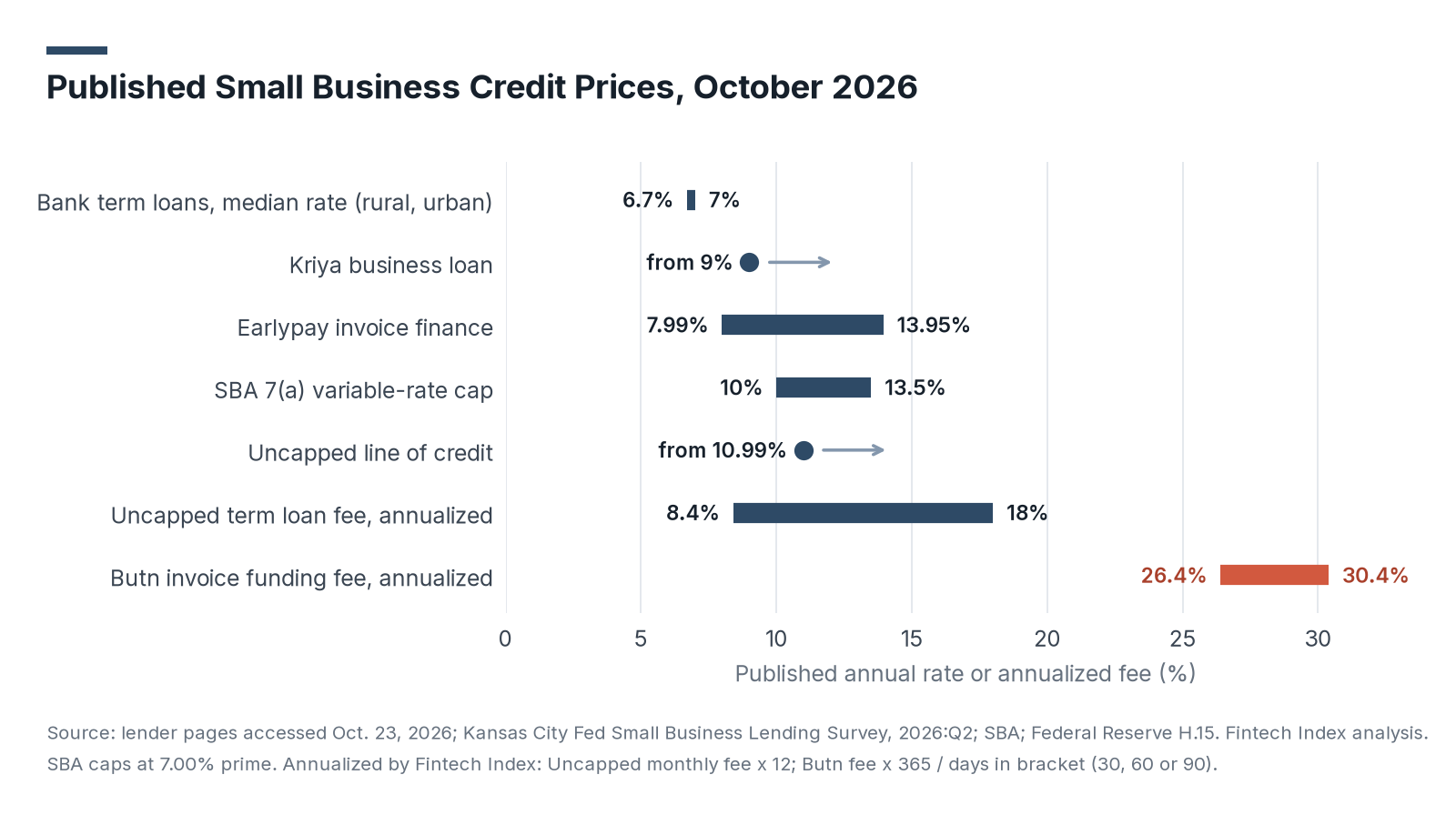
Banks lend for less. In the Kansas City Fed's survey of 146 banks for the second quarter of 2026, the median rate on new variable-rate term loans to small businesses was 7% at urban banks and 6.7% at rural banks. The SBA caps variable rates on 7(a) loans at the prime rate plus 3.0 to 6.5 points depending on size, which at the 7.00% prime rate in late October 2026 means 13.5% on loans of $50,000 or less and 10.0% on loans over $350,000.
| Lender and example | Amount funded | Fee | Total repaid | Fee share |
|---|---|---|---|---|
| Parafin via DoorDash, cash advance | $10,000 | $750 | $10,750 | 7.5% |
| Parafin, cash advance | $9,000 | $1,080 | $10,080 | 12.0% |
| Liberis via Lloyds Bank, cash advance | $13,192 | $1,979 | $15,171 | 15.0% |
| Capify UK, loan with fees at the published cap | $13,192 | $1,252 | Not published | 9.5% |
| Uncapped, 6-month term loan at the 1% average fee | $10,000 | $600 | $10,600 | 6.0% |
| Butn, first invoice due in 60 days | $6,450 | $419 | $6,450 | 6.5% |
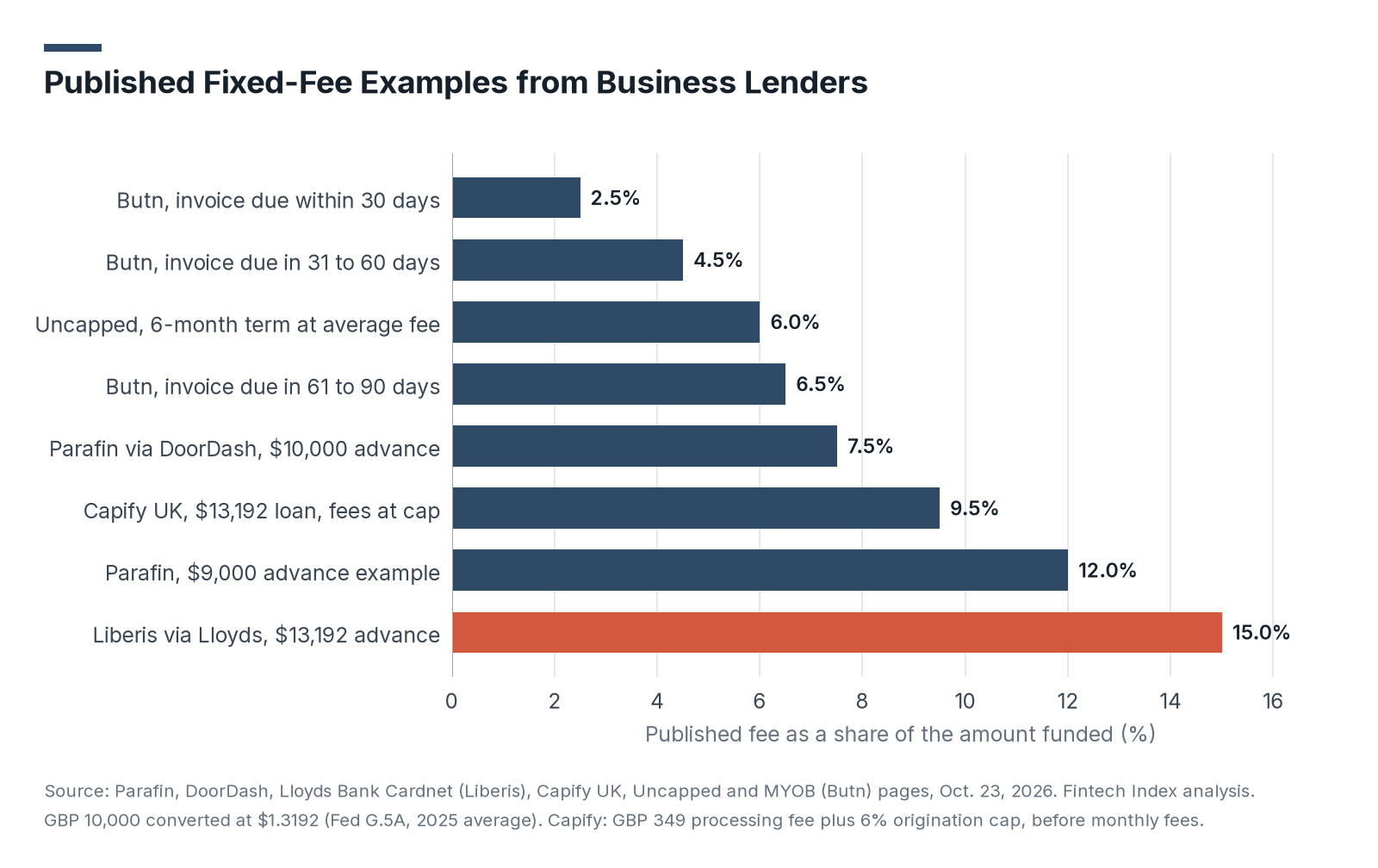
- The Liberis example through Lloyds Bank carries the highest fee in the set, 15% of the advance, with 20% of each day's card sales going to repayment.
- Butn takes its fees out of the invoice before paying it out, and the business repays the full invoice value on the repayment date.
- Capify's fees at the cap come to 9.5% of a $13,192 loan before its $32.85 monthly service fee.
Small Business Loan Approval Rates by Lender Type
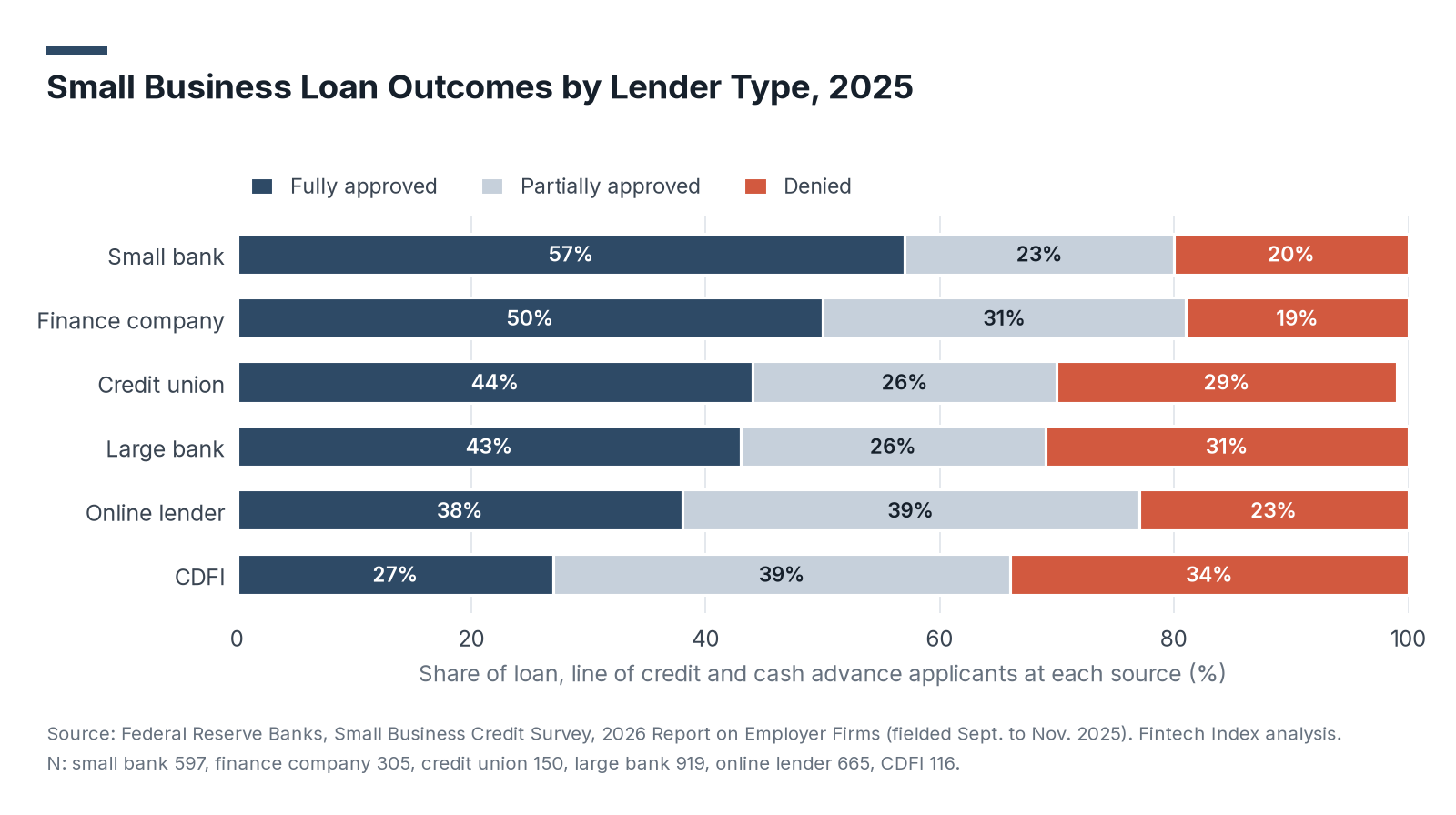
Small banks fully approved 57% of the small businesses that applied to them for a loan, line of credit or cash advance in 2025, the highest share of any lender type in the Fed survey. Online lenders, the survey's category for fintech lenders, fully approved 38% but partially approved another 39%, so 77% of their applicants left with at least some money.
| Lender type | Applicants | Fully approved | Partially approved | Denied | Fully approved, 2024 |
|---|---|---|---|---|---|
| Small bank | 597 | 57% | 23% | 20% | 54% |
| Finance company | 305 | 50% | 31% | 19% | 47% |
| Credit union | 150 | 44% | 26% | 29% | 47% |
| Large bank | 919 | 43% | 26% | 31% | 45% |
| Online lender | 665 | 38% | 39% | 23% | 30% |
| CDFI | 116 | 27% | 39% | 34% | 42% |
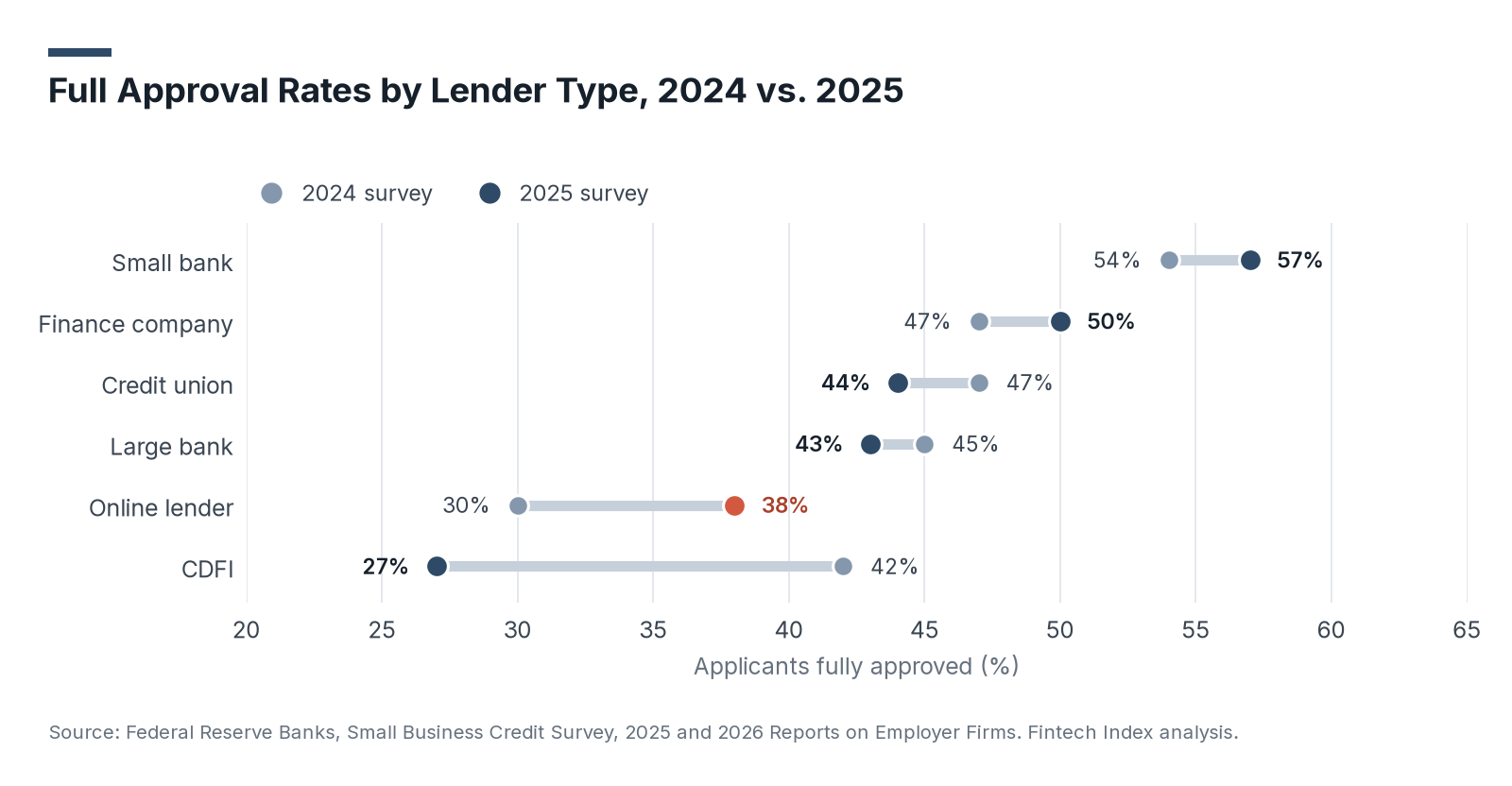
Online lenders gained the most from one survey to the next. Their full approval rate rose from 30% to 38%, while large banks slipped from 45% to 43% and community development financial institutions (CDFIs) fell from 42% to 27%, on a sample of 116 applicants.
- Large banks denied 31% of applicants, the most of any lender type except CDFIs.
- Online lenders' share of applicants for financing rose from 17% in the 2020 survey to 29% in the 2025 survey.
- Among applicants with less than $1 million in revenue, 64% were at least partially approved at large banks, against 75% to 79% at finance companies, small banks and online lenders.
Approval Rates Over Time, 2018 to 2025
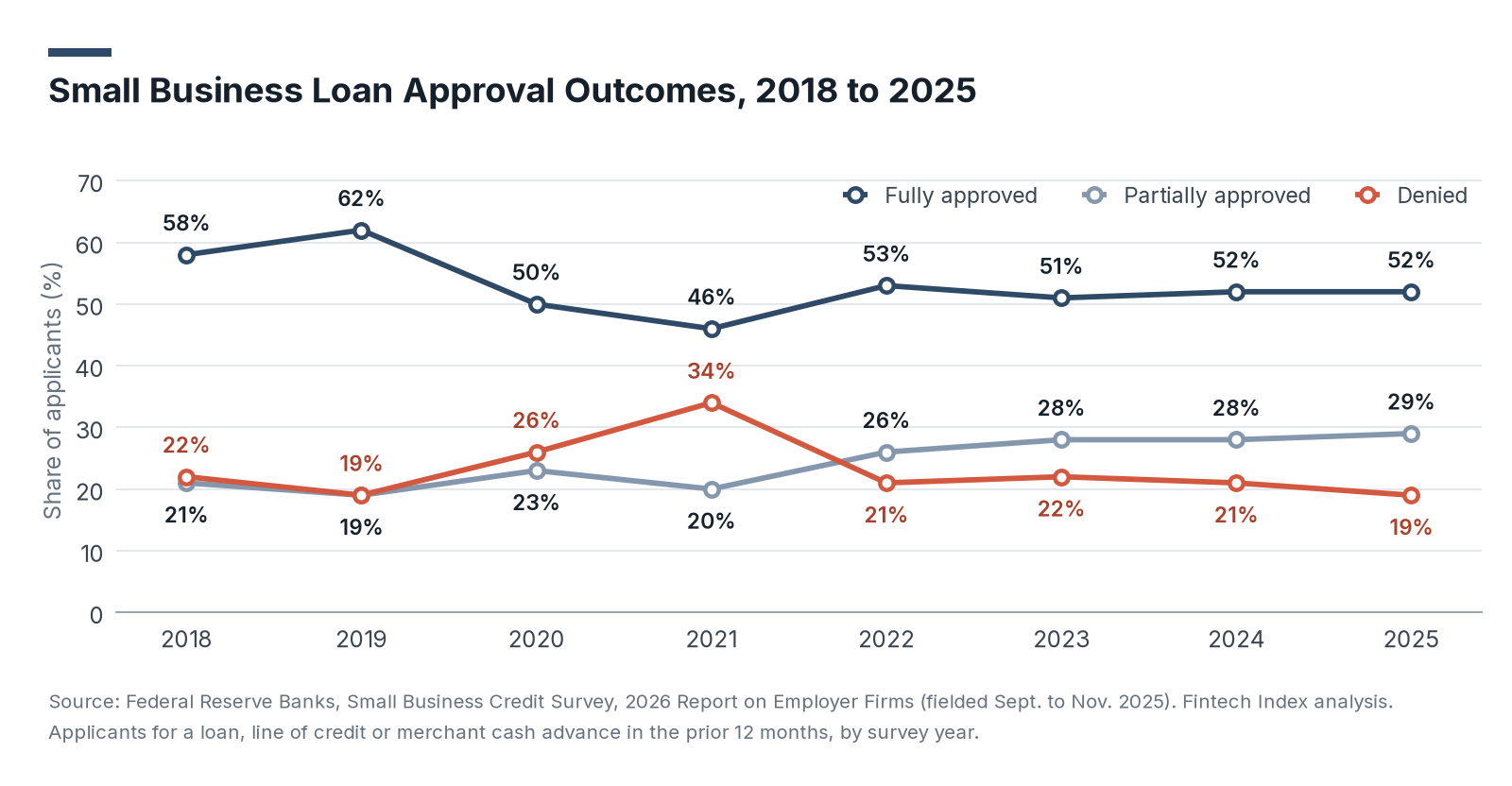
The share of applicants that got everything they asked for has held at 51% to 53% for four straight surveys, ten points below the 62% of 2019. Partial approvals have taken up most of the difference, rising from 19% to 29%, while denials are back to 19%, the same as before the pandemic.
| Survey year | Applicants | Fully approved | Partially approved | Denied |
|---|---|---|---|---|
| 2018 | 2,297 | 58% | 21% | 22% |
| 2019 | 1,835 | 62% | 19% | 19% |
| 2020 | 2,433 | 50% | 23% | 26% |
| 2021 | 2,426 | 46% | 20% | 34% |
| 2022 | 3,026 | 53% | 26% | 21% |
| 2023 | 2,171 | 51% | 28% | 22% |
| 2024 | 2,724 | 52% | 28% | 21% |
| 2025 | 2,270 | 52% | 29% | 19% |
Banks see the same pattern from the lending side. About 8% more banks, on net, tightened their small business credit standards than eased them in the Kansas City Fed's survey for the second quarter of 2026, and about 69% cited borrower financials as the most common reason for a denial. New small business loan balances at the surveyed banks were still up 8.5% from a year earlier.
Approval Rates by Loan Product
Secured loans for vehicles and equipment had the highest full approval rate in 2025, at 71%. SBA-guaranteed loans and lines of credit had the lowest, at 32%, and the highest denial rate, at 40%. Merchant cash advances, the product Parafin and Liberis sell, were fully approved for 48% of applicants and denied for 12%, the lowest denial rate after auto and equipment loans.
| Product | Applicants | Fully approved | Partially approved | Denied |
|---|---|---|---|---|
| Auto or equipment loan | 294 | 71% | 17% | 11% |
| Mortgage | 137 | 55% | 23% | 22% |
| Merchant cash advance | 298 | 48% | 40% | 12% |
| Business line of credit | 977 | 45% | 31% | 24% |
| Personal loan | 157 | 40% | 31% | 30% |
| Business loan | 683 | 37% | 35% | 28% |
| Home equity line of credit | 110 | 35% | 35% | 30% |
| SBA loan or line of credit | 359 | 32% | 29% | 40% |
SBA lending still reached a large number of businesses. The SBA backed about 84,400 7(a) and 504 loans worth $44.8 billion in fiscal 2025, including about 77,600 7(a) loans worth $37 billion, an average of about $477,000 each. The agency guarantees 85% of 7(a) loans of $150,000 or less and 75% of larger ones, and 7(a) loans can run up to $5 million and 10 years, or 25 years for real estate.
- SBA loans are the hardest product to get in full, but their rates are capped at 10.0% to 13.5% at today's prime rate, below the 26% to 30% a year that Butn's invoice fees work out to.
- Merchant cash advance applicants were the most likely to be partially approved, at 40%.
Approval Rates by Firm Size, Age and Credit Risk
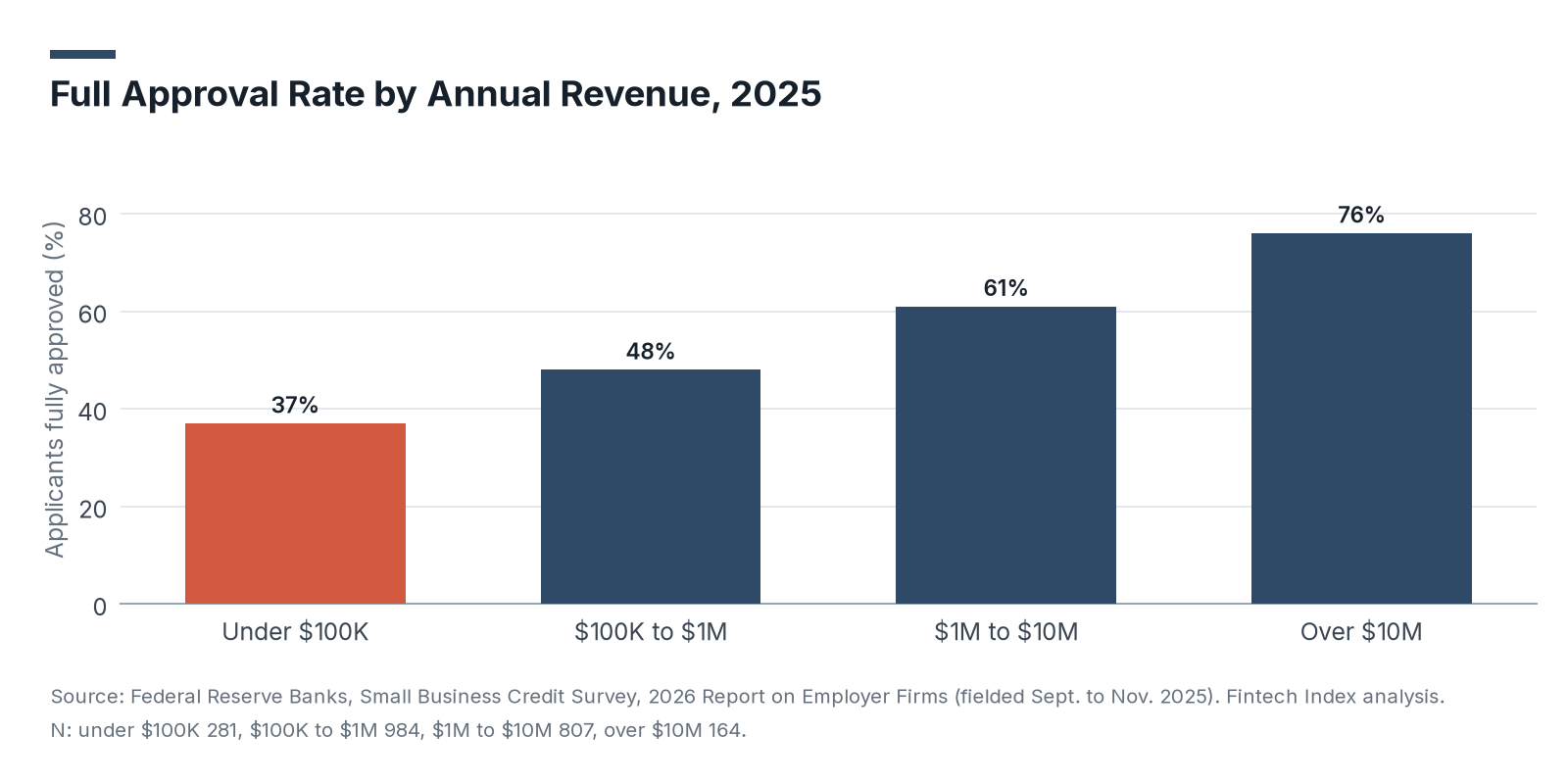
Revenue made the biggest difference to approval. Firms with less than $100,000 in annual revenue were fully approved 37% of the time, against 76% for firms with more than $10 million. Several lenders in our study set revenue floors of their own: Capify asks for $13,192 a month in turnover and Kriya's invoice finance for $131,920 a month in invoices.
| Lender type | Low credit risk | Medium or high credit risk | Gap, points |
|---|---|---|---|
| Finance company | 90% | 66% | 24 |
| Online lender | 87% | 70% | 17 |
| Small bank | 85% | 61% | 24 |
| Large bank | 74% | 54% | 20 |
- Online lenders approved at least part of the request for 70% of medium- and high-risk applicants, the highest share of any lender type.
- Firms 21 years or older were fully approved 63% of the time, against 48% for firms up to five years old.
- 57% of applicants with non-Hispanic White owners were fully approved, against 39% with Asian owners, 33% with Hispanic owners and 32% with Black owners. The survey does not adjust these shares for credit risk or profitability.
- By industry, manufacturers had the highest full approval rate, at 63%, and healthcare and education firms the lowest, at 39%.
Why Firms Chose Their Lender, and What They Paid
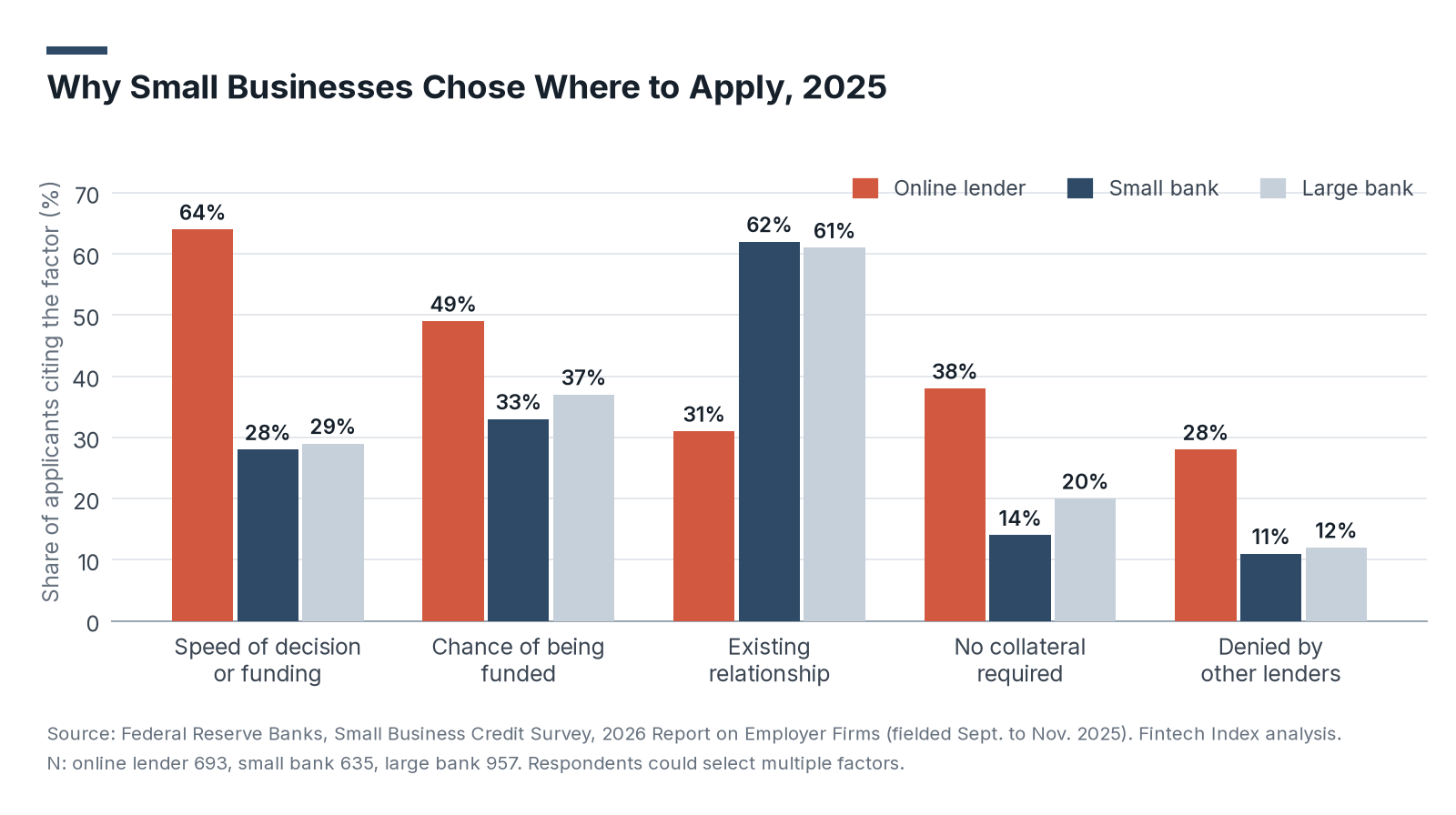
Businesses that went to online lenders were buying speed. 64% of online lender applicants cited the speed of the decision or funding as a reason they applied there, against 28% at small banks and 29% at large banks, and 28% said another lender had already turned them down. Bank applicants were most likely to cite an existing relationship.
| Lender type | Accepted the offer | Cost higher than expected | Satisfied | Dissatisfied |
|---|---|---|---|---|
| Credit union | 94% | 31% | 76% | 3% |
| Small bank | 89% | 37% | 65% | 6% |
| Large bank | 87% | 32% | 64% | 8% |
| Finance company | 90% | 44% | 57% | 12% |
| Online lender | 84% | 60% | 35% | 15% |
- 60% of online lender borrowers said their total cost turned out higher than they expected when they accepted, nearly twice the 32% at large banks.
- Only 35% of businesses approved by an online lender were satisfied with it, against 76% at credit unions.
- 59% of employer firms with debt had backed it with a personal guarantee. Parafin's DoorDash program and Uncapped say they ask for none, while Capify asks the majority owner for one on unsecured loans and Liberis asks for one from limited companies.
What Small Business Loan Approval Rates Mean for 2027 and Beyond
Small banks still say yes in full more often than any other lender, but the lenders in our study compete on a different promise: money within a day, decided on sales data, often without a personal guarantee or a credit check. That speed is priced into a fixed fee that can equal an annual rate of 26% to 30% on a short invoice, and it shows in the Fed survey, where online lender borrowers were the most likely to find the cost higher than expected and the least likely to be satisfied.
The gap between full and partial approvals is now the main story. Online lenders' full approval rate rose eight points in a year while banks tightened standards on net, and online lenders have grown from 17% to 29% of applicants since 2020. With the prime rate at 7.00%, any cut lowers capped SBA rates and variable bank rates, while the fixed fees in our study are not tied to it, which would widen the price gap that a business pays for speed.
So if you run a small business that needs credit, apply to a bank or SBA lender first when you can wait a week or more, and when you cannot, convert any fixed fee you are offered into an annual rate before you sign.
Data Collection and Methodology
The Fintech Index research team collected the loan amounts, fees, rates, eligibility rules and funding times that Parafin, Liberis, Capify, Kriya, Uncapped, Earlypay and Butn published on their own websites, or on the pages of partners that offer their products (DoorDash for Parafin, Lloyds Bank Cardnet for Liberis and MYOB for Butn), on October 23, 2026. Lenders set each offer by the business's sales, credit and trading history, so the published figures are ranges, starting prices and worked examples rather than the terms every applicant gets. None of the seven publishes an approval rate for all applicants.
All money is shown in US dollars. Pounds are converted at $1.3192 and Australian dollars at $0.6450, the Federal Reserve's 2025 annual average rates (G.5A release of January 5, 2026); the same rates are used throughout. Capify's fee example applies its published processing fee for a £10,000 loan (£349) and its 6% origination cap, and leaves out the £24.90 monthly service fee. The Uncapped example applies its published 6% base fee for a 6-month term to an illustrative $10,000 loan. The Butn example is MYOB's worked example of a first invoice due in 60 days, with the $199 (Australian) establishment fee and the 4.5% funding fee.
Annualized fees are simple, uncompounded rates calculated by The Fintech Index. Uncapped's monthly fee is multiplied by 12. Butn's fee for each bracket is multiplied by 365 and divided by the bracket's longest period (30, 60 or 90 days), which gives the lowest annual rate for that bracket. Merchant cash advance fees from Parafin and Liberis are shown only as a share of the advance, because repayment time depends on the business's sales and has no fixed term.
Approval outcomes come from the Federal Reserve Banks' Small Business Credit Survey, fielded September 3 to November 14, 2025, with 6,525 responses from US employer firms with 1 to 499 employees, published in the 2026 Report on Employer Firms; the prior-year comparison comes from the 2025 Report on Employer Firms. Outcomes cover applicants for a loan, line of credit or merchant cash advance in the prior 12 months and exclude pending applications. Shares are weighted survey results, may not sum to 100 because of rounding, and are not adjusted for credit risk or profitability unless stated. The survey's online lenders are US nonbank lenders that operate online, so they do not include most of the UK and Australian lenders in our study.
Bank rates come from the Federal Reserve Bank of Kansas City's Small Business Lending Survey for the second quarter of 2026, with 146 responding banks. SBA 7(a) rate caps are the SBA's published maximum spreads over the prime rate, applied to the 7.00% bank prime rate in the Federal Reserve's H.15 release for the week ending October 21, 2026. SBA loan counts are the agency's fiscal 2025 totals as of September 30, 2025.
Sources
- Fintech Index, Small Business Lender Study: analysis of published loan amounts, fees, rates, eligibility rules and funding times from seven business lenders reviewed by The Fintech Index (Parafin, Liberis, Capify, Kriya, Uncapped, Earlypay and Butn), conducted October 2026.
- Federal Reserve Banks, Small Business Credit Survey, 2026 Report on Employer Firms
- Federal Reserve Banks, Small Business Credit Survey, 2025 Report on Employer Firms
- Federal Reserve Bank of Kansas City, Small Business Lending Survey, 2026:Q2
- U.S. Small Business Administration, 7(a) Loan Program Terms, Conditions and Eligibility
- U.S. Small Business Administration, fiscal 2025 lending totals, September 30, 2025
- Federal Reserve, H.15 Selected Interest Rates
- Federal Reserve, G.5A Foreign Exchange Rates (Annual), January 5, 2026
- Parafin, homepage
- Parafin, Capital
- DoorDash, DoorDash Capital
- DoorDash Capital, What Is the Capital Fee
- Liberis, Working Capital
- Lloyds Bank Cardnet, Merchant Cash Advance
- Capify UK, homepage
- Capify UK, Fees
- Kriya, Kriya Business Loans Are Back, October 6, 2026
- Kriya, Invoice Finance for Brokers
- Uncapped, FAQs
- Earlypay, Invoice Financing
- MYOB, Invoice Finance with Butn
- MYOB, Get Invoice Funding with Butn