Overdraft Fee Statistics: 2026 Report

Our analysts reviewed overdraft and nonsufficient funds fee revenue reported by banks with more than $1 billion in assets from 2019 through June 2026, five years of Bankrate fee surveys, Federal Reserve survey data on who paid an overdraft fee in 2025, and the published overdraft terms of five companies rated on The Fintech Index, to understand what overdrafts cost consumers as of Q4 2026.
Key Findings
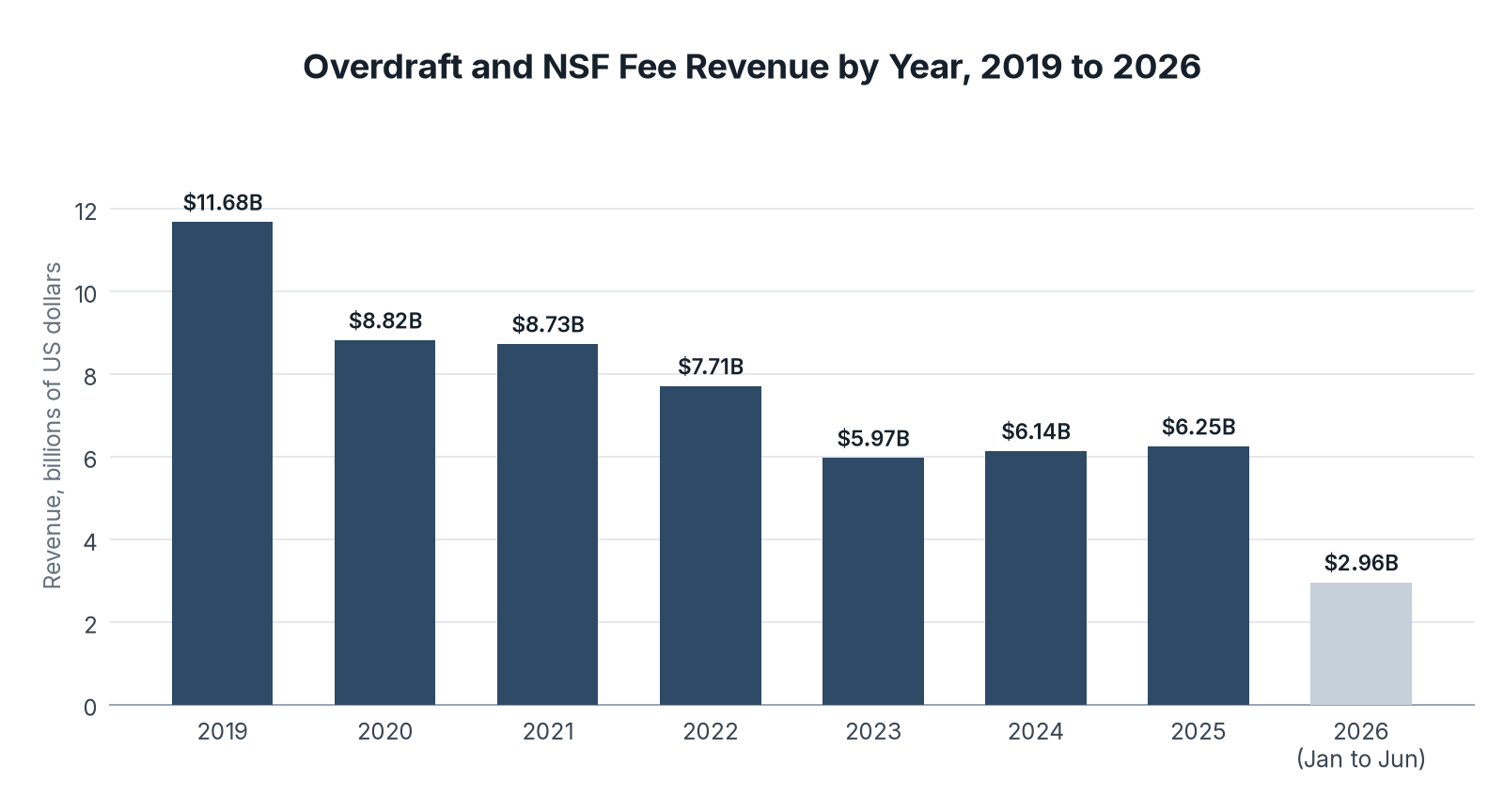
- Banks with more than $1 billion in assets collected $6.25 billion in overdraft and NSF fees in 2025, down 46.5% from $11.68 billion in 2019, and $2.96 billion in the first half of 2026.
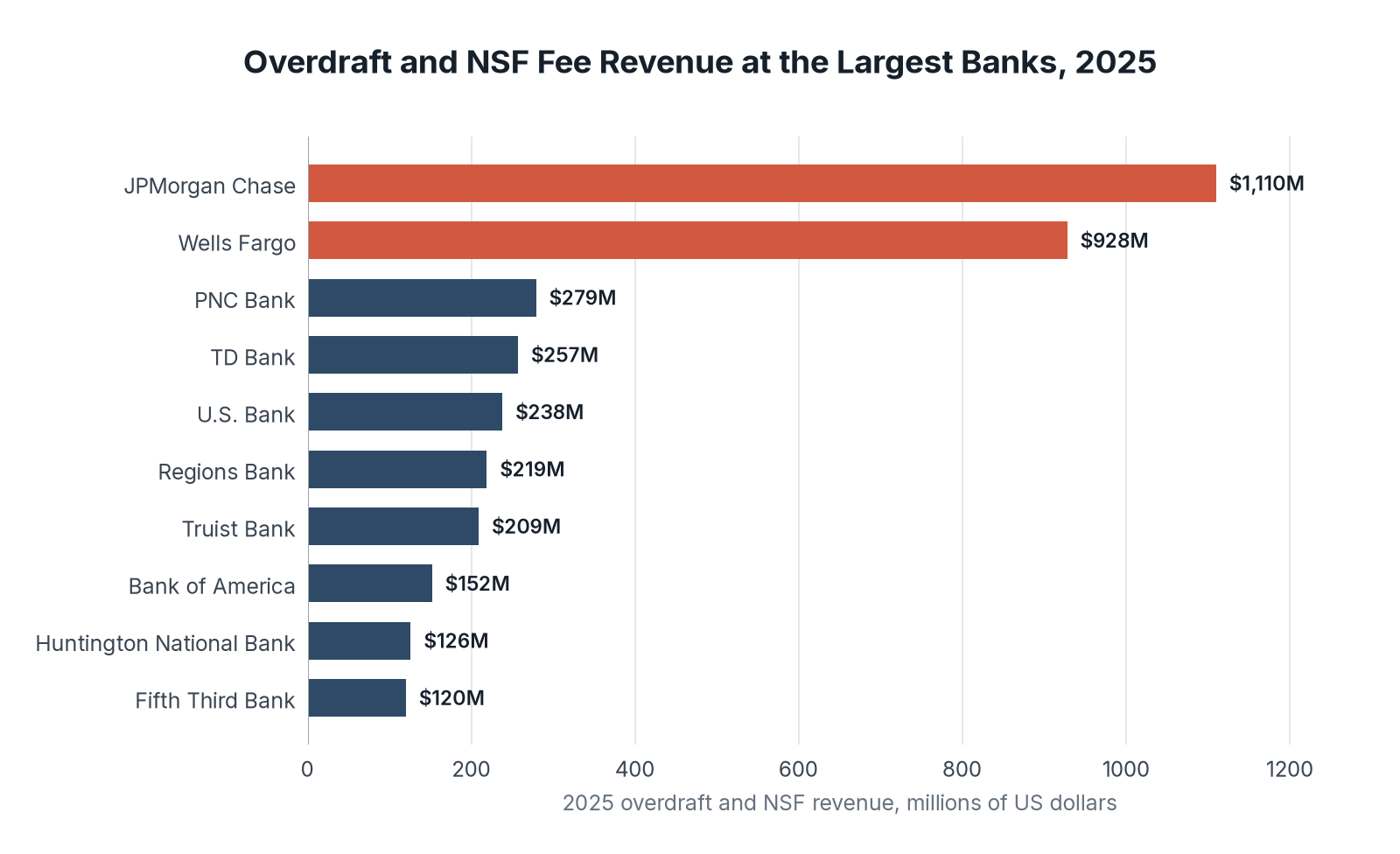
- JPMorgan Chase and Wells Fargo collected $2.04 billion of the 2025 total, or 32.6%.
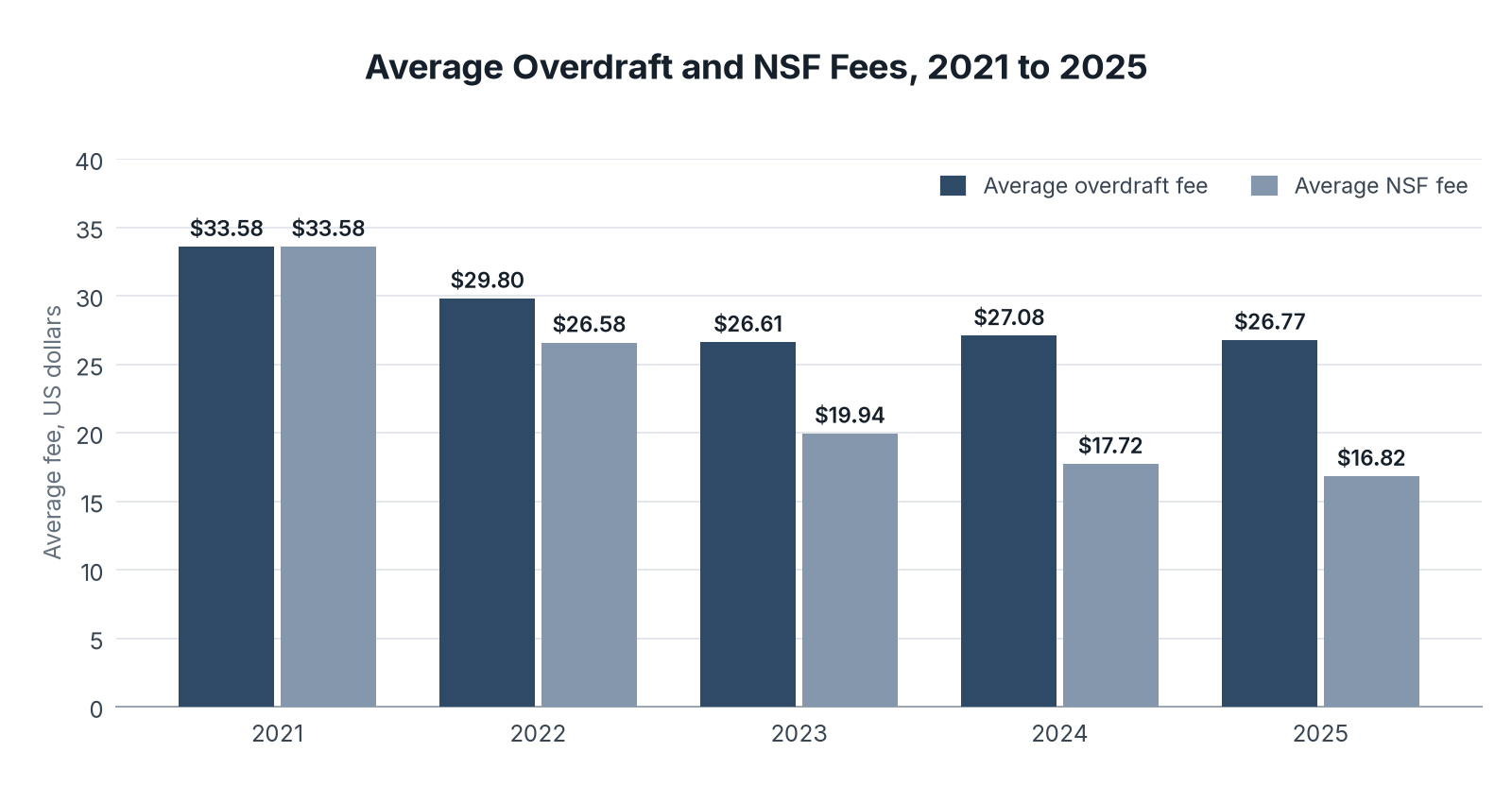
- The average overdraft fee fell 20.3% from $33.58 in 2021 to $26.77 in 2025, and 94% of surveyed accounts still charge one.
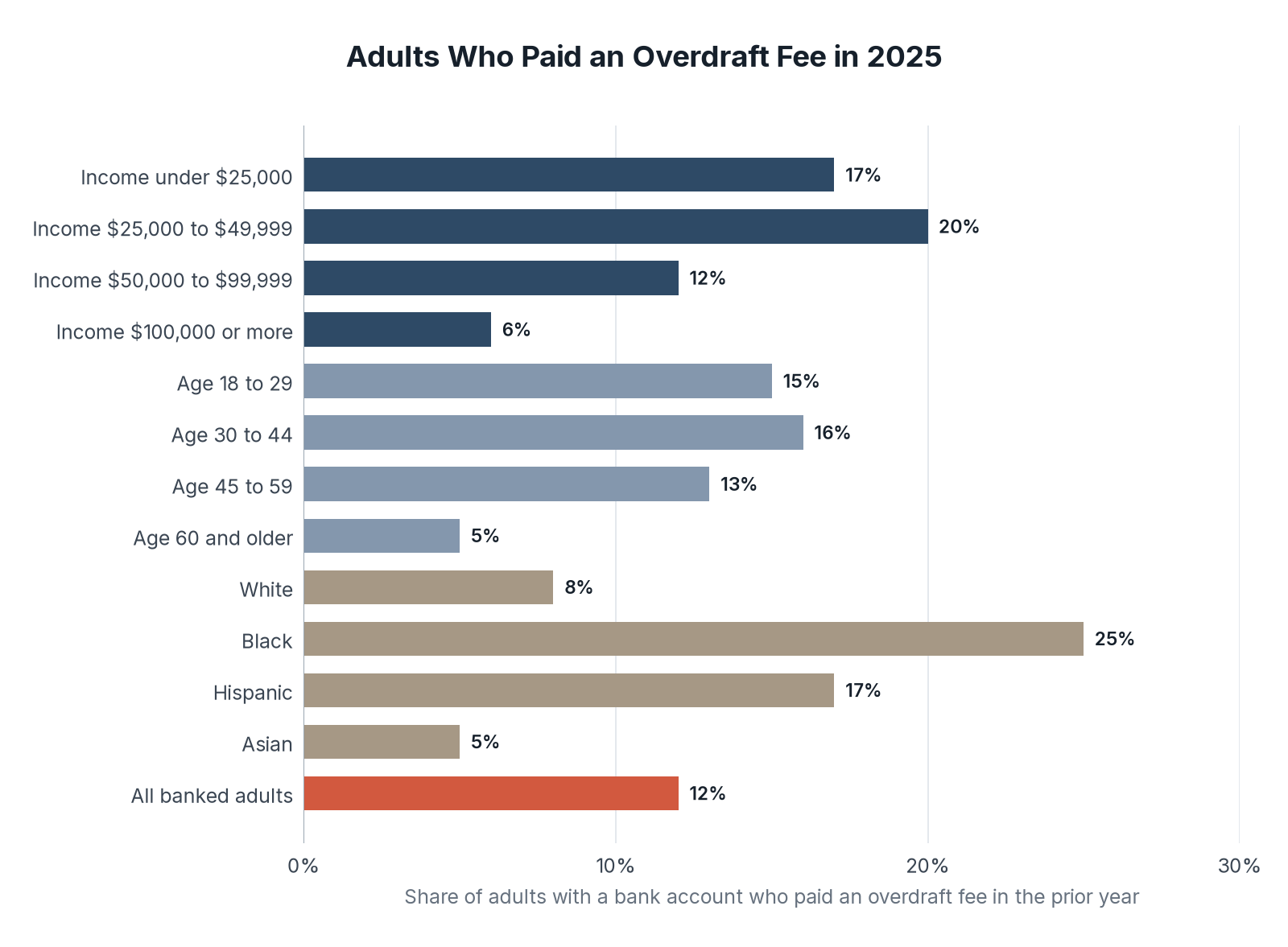
- 12% of adults with a bank account paid an overdraft fee in 2025, including 25% of Black adults and 20% of adults with family income of $25,000 to $49,999.
- Four of the five rated companies we checked charge no overdraft fee, while Dave's ExtraCash advance carries a fee of $5 or 5%, whichever is greater.
An overdraft fee is the charge a bank adds when it pays a transaction the account does not have the money to cover. A nonsufficient funds, or NSF, fee is the charge for declining that payment instead. Both fees fall hardest on customers with the smallest balances, and many digital banks and fintech apps now compete by charging neither.
We gathered annual overdraft and NSF revenue from a Motley Fool Money analysis of FFIEC Call Report data, average fees from Bankrate's annual Checking Account and ATM Fee Study, and the share of adults paying overdraft fees from the Federal Reserve's survey of household economics. We then read the fee terms of the banking companies we rate.
In the following sections, we compare overdraft revenue by year, revenue at the largest banks, average overdraft and NSF fees, who pays overdraft fees, and the overdraft terms of rated companies.
Bank Overdraft Revenue Has Held Near $6 Billion Since 2023
Total fee revenue shows how much consumers pay for overdrafts each year. We gathered combined overdraft and NSF revenue for banks with more than $1 billion in assets, the banks required to report it, from 2019 through June 2026.
| Year | Overdraft and NSF revenue | Change from prior year |
|---|---|---|
| 2019 | $11.68B | No prior year in this data |
| 2020 | $8.82B | -24.5% |
| 2021 | $8.73B | -1.0% |
| 2022 | $7.71B | -11.7% |
| 2023 | $5.97B | -22.6% |
| 2024 | $6.14B | +2.8% |
| 2025 | $6.25B | +1.8% |
| 2026, January to June | $2.96B | Half year |
Key Findings
- Revenue fell 48.9% from 2019 to 2023 as large banks cut fees, then rose 4.7% from 2023 to 2025.
- The $2.96 billion collected in the first half of 2026 puts the year on pace for about $5.9 billion, close to the 2024 and 2025 totals.
- These totals leave out banks with $1 billion or less in assets and all credit unions, so consumers pay more than the reported figure.
Two Banks Collect About A Third Of Reported Overdraft Fees
Overdraft revenue is concentrated at a few of the largest banks, so their fee policies shape what most customers pay. We gathered overdraft and NSF revenue for the 10 banks that collected the most in the first half of 2026.
| Bank | 2024 | 2025 | January to June 2026 |
|---|---|---|---|
| JPMorgan Chase | $1.03B | $1.11B | $562M |
| Wells Fargo | $1.00B | $928M | $457M |
| PNC Bank | $261M | $279M | $144M |
| TD Bank | $230M | $257M | $132M |
| U.S. Bank | $230M | $238M | $118M |
| Regions Bank | $199M | $219M | $113M |
| Bank of America | $148M | $152M | $113M |
| Truist Bank | $266M | $209M | $98M |
| Huntington National Bank | $111M | $126M | $78M |
| Fifth Third Bank | $108M | $120M | $63M |
Key Findings
- JPMorgan Chase collected $562 million in the first half of 2026, 19.0% of the $2.96 billion reported by all banks in the data.
- Bank of America collected $152 million in 2025, down 90.3% from $1.56 billion in 2019, after it cut its overdraft fee to $10 and dropped its NSF fee.
- Capital One and Citibank have eliminated overdraft and NSF fees, and they collected $1 million and $2 million in 2023, down from $154 million and $109 million in 2019.
The Average Overdraft Fee Has Fallen About 20% Since 2021
The fee a single overdraft costs matters more to a customer than a bank's total revenue. We gathered the average overdraft and NSF fees from Bankrate's annual survey of checking accounts at 245 banks and thrifts.
| Survey year | Average overdraft fee | Average NSF fee |
|---|---|---|
| 2021 | $33.58 | $33.58 |
| 2022 | $29.80 | $26.58 |
| 2023 | $26.61 | $19.94 |
| 2024 | $27.08 | $17.72 |
| 2025 | $26.77 | $16.82 |
Key Findings
- The average overdraft fee fell 20.3% from its record of $33.58 in 2021 to $26.77 in 2025, and has held between $26 and $28 since 2023.
- The average NSF fee fell 36.7% from 2022 to 2025, and only 61% of surveyed accounts still charged one in 2025.
- 94% of surveyed accounts still charged an overdraft fee in 2025, and a 2024 CFPB rule that would have let large banks charge as little as $5 per overdraft was overturned by Congress in 2025.
One In Eight Banked Adults Paid An Overdraft Fee In 2025
Who pays overdraft fees shows which customers gain the most from a fee-free account. We gathered the share of adults with a bank account who paid an overdraft fee in the prior 12 months, by income, age, and race and ethnicity.
| Group | Category | Paid an overdraft fee in the prior year |
|---|---|---|
| Family income | Less than $25,000 | 17% |
| Family income | $25,000 to $49,999 | 20% |
| Family income | $50,000 to $99,999 | 12% |
| Family income | $100,000 or more | 6% |
| Age | 18 to 29 | 15% |
| Age | 30 to 44 | 16% |
| Age | 45 to 59 | 13% |
| Age | 60 and older | 5% |
| Race and ethnicity | White | 8% |
| Race and ethnicity | Black | 25% |
| Race and ethnicity | Hispanic | 17% |
| Race and ethnicity | Asian | 5% |
| Overall | All adults with a bank account | 12% |
Key Findings
- 12% of banked adults paid an overdraft fee in 2025, up 1 percentage point from 2021.
- Adults with family income of $25,000 to $49,999 were more than three times as likely to pay an overdraft fee as those with $100,000 or more.
- 25% of Black adults with a bank account paid an overdraft fee, about three times the 8% rate for White adults.
Most Rated Companies We Checked Charge No Overdraft Fee
The fee terms of fintech accounts show how they compare with the banks that still charge. We read the published overdraft terms of five banking and cash advance companies rated on The Fintech Index.
| Company | Account | Overdraft fee | Other overdraft terms | Fintech Index rating |
|---|---|---|---|---|
| Mercury | Business checking | None | No monthly fees or minimum balance | 84 |
| Revolut | US prepaid account | None | No overdraft or credit feature | 84 |
| Starling | UK personal current account | None | Arranged overdraft interest of 15%, 25%, or 35% EAR, and no charges on unarranged overdrafts | 82 |
| Acorns | Acorns Checking | None | No minimum balance fees | 76 |
| Dave | ExtraCash | Greater of $5 or 5% of the advance | Advances of $25 to $500, up to $5 monthly membership, and no interest or late fees | 74 |
Key Findings
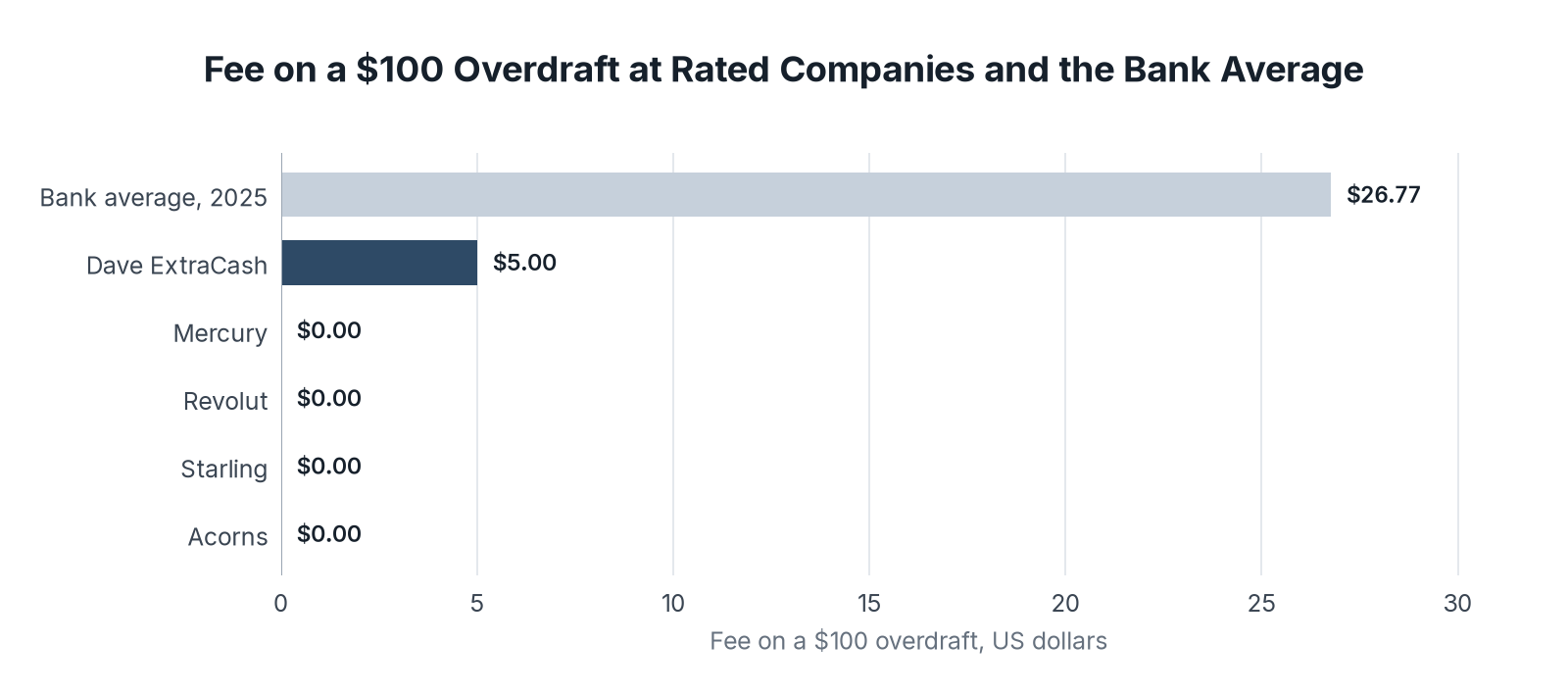
- Mercury, Revolut, Starling, and Acorns charge no overdraft fee, against the $26.77 bank average in 2025.
- Dave's ExtraCash is legally an overdraft, and its fee of $5 or 5%, whichever is greater, comes to $5 on a $100 advance, about a fifth of the bank average.
- Starling charges interest instead of fees: a £1,200 arranged overdraft used for 30 days at 15% EAR costs £13.86, about $18.57.
What Overdraft Data Means For Bank Customers In 2026
Overdraft fees have fallen sharply since 2019, as large banks cut fees and dropped NSF charges, but reported revenue has held near $6 billion a year since 2023. The average fee is still about $27, nearly every surveyed bank account charges one, and the customers who pay are most often those with lower incomes.
With the 2024 CFPB overdraft rule overturned, any further decline now depends on bank policy and competition. Fee-free accounts from digital banks and fintech companies give customers who overdraw often a direct way to stop paying.
So if you overdraw your account more than once a year, move your everyday spending to an account that declines payments or charges no overdraft fee.
Data Collection and Methodology
Overdraft and NSF revenue comes from a Motley Fool Money analysis of FFIEC Call Report data, Schedule RI, item RIADH032, which combines overdraft and NSF fee revenue on consumer deposit accounts. Only banks with more than $1 billion in assets must report this item, so totals exclude smaller banks and all credit unions. The 2026 figure covers January through June for 507 of 512 reporting banks and January through March for five. The full-year 2026 pace is our calculation, doubling the six-month total. The CFPB's own analysis of the same data, which adjusts for bank mergers, put 2019 revenue at $11.96 billion and 2023 revenue at $5.83 billion, so its figures differ slightly from the series in our table. The 2019 and 2023 figures for Bank of America, Capital One, and Citibank come from the CFPB analysis.
Average fees come from Bankrate's Checking Account and ATM Fee Study for each year from 2021 to 2025. The 2025 study surveyed 245 financial institutions in 25 large US markets from June 2 to July 3, 2025. In 2021, Bankrate reported one combined overdraft and NSF fee, so both columns show the same value for that year. The share of adults paying an overdraft fee comes from the Federal Reserve's Survey of Household Economics and Decisionmaking, among adults with a bank account.
For rated companies, we read the published fee terms of five banking and cash advance companies rated on The Fintech Index on November 3, 2026. Starling figures are in pounds and were converted to US dollars at the Federal Reserve H.10 rate of $1.3398 per pound on October 30, 2026. All other figures are in US dollars. The Fintech Index rating is the rounded average of the eight criterion scores on each company's review page.
Sources
- Motley Fool Money, Overdraft Fee Statistics, updated September 4, 2026
- Bankrate, ATM Fees Hit Record High for Third Consecutive Year, September 10, 2025
- Bankrate, ATM Fees Hit Record High; Overdraft and NSF Fees Down Sharply, 2023
- Bankrate, ATM Fees Rise to Three-Year High, August 31, 2022
- Bankrate, Overdraft Fees Hit All-Time High, October 20, 2021
- Federal Reserve, Economic Well-Being of U.S. Households in 2025, Banking, May 2026
- The Fintech Index analysis of rated companies, conducted November 2026
- Mercury, Business Banking
- Revolut, Consumer Prepaid Cardholder Agreement, effective November 18, 2025
- Starling Bank, Personal Overdraft
- Acorns, Acorns Banking
- Dave, ExtraCash
- Consumer Financial Protection Bureau, Overdraft/NSF Revenue in 2023 Down More Than 50% Versus Pre-Pandemic Levels, April 24, 2024
- Table, Overdraft and NSF Fee Revenue at Banks With More Than $1 Billion in Assets: Source: Motley Fool Money analysis of FFIEC Call Report data (Source 1), as of September 2026. Data: overdraft_nsf_revenue_by_year.csv
- Chart, Overdraft and NSF Fee Revenue at Banks With More Than $1 Billion in Assets: Source: Motley Fool Money analysis of FFIEC Call Report data. Covers banks with more than $1 billion in assets. 2026 covers January to June.
- Table, Overdraft and NSF Fee Revenue at the Largest Banks: Source: Motley Fool Money analysis of FFIEC Call Report data (Source 1). Data: overdraft_revenue_by_bank.csv
- Chart, Overdraft and NSF Fee Revenue at the Largest Banks: Source: Motley Fool Money analysis of FFIEC Call Report data.
- Table, Average Overdraft and NSF Fees: Source: Bankrate, Checking Account and ATM Fee Study, 2021 to 2025 (Sources 2 to 5). Data: average_overdraft_and_nsf_fees.csv
- Chart, Average Overdraft and NSF Fees: Source: Bankrate, Checking Account and ATM Fee Study. In 2021, Bankrate reported one combined overdraft and NSF fee.
- Table, Adults Who Paid an Overdraft Fee in 2025: Source: Federal Reserve, Economic Well-Being of U.S. Households in 2025 (Source 6), among adults with a bank account. Data: who_paid_overdraft_fee_2025.csv
- Chart, Adults Who Paid an Overdraft Fee in 2025: Source: Federal Reserve, Economic Well-Being of U.S. Households in 2025. Among adults with a bank account.
- Table, Overdraft Terms at Rated Companies: Source: The Fintech Index analysis of rated companies (Source 7), from company fee terms (Sources 8 to 12), as of November 3, 2026. Data: rated_company_overdraft_terms.csv
- Chart, Overdraft Terms at Rated Companies: Source: The Fintech Index analysis of rated company fee terms, and Bankrate, Checking Account and ATM Fee Study. The bank average comes from a survey of bank accounts, while the company figures come from each company's published terms, so the two are measured on different bases.