Fintech Lender Charge-Off Rates: 2026 Report
How much of the money online lenders hand out never comes back? We took the write-off figures that publicly traded lenders report in their own filings.

Online lenders write off part of the money they lend each year as uncollectible. Some lose far more than others.
Our analysts studied six publicly traded lenders that make consumer or small business loans online. They are Happen (the company formerly called LendingClub), SoFi, Enova, OppFi, Oportun and Affirm. We used each lender's latest full-year figures, with 2024 and second-quarter 2026 rates for comparison.
In the following sections, we compare rates by lender and product, then show how they changed from 2024 and where they stood in mid-2026.
Fintech Lender Charge-Off Rates by Lender and Product
The Fintech Index research team listed each lender's latest full-year rate, by product where its filing gives one.
| Lender | Product or Segment | Fiscal Year | Net Charge-Off Rate | Basis |
|---|---|---|---|---|
| Enova | Consumer loans | 2025 | 61.8% | Sum of four quarterly ratios, average combined loans and finance receivables |
| OppFi | Installment loans | 2025 | 49.4% | Company ratio, average receivables |
| Enova | All loans | 2025 | 33.6% | Sum of four quarterly ratios |
| Enova | Small business loans | 2025 | 18.4% | Sum of four quarterly ratios |
| Oportun | All loans | 2025 | 12.0% | Company annualized ratio |
| Affirm | All loans held for investment | Ended June 2026 | 7.50% | Calculated: $611.6M net charge-offs on $8,150.6M average loans |
| SoFi | Credit cards | 2025 | 7.15% | Company ratio |
| Happen (formerly LendingClub) | All loans held for investment | 2025 | 3.6% | Company ratio, loans at amortized cost |
| SoFi | Personal loans | 2025 | 2.86% | Company ratio, excludes delinquent loans sold |
| SoFi | All loans | 2025 | 2.07% | Company ratio |
| SoFi | Student loans | 2025 | 0.72% | Company ratio |
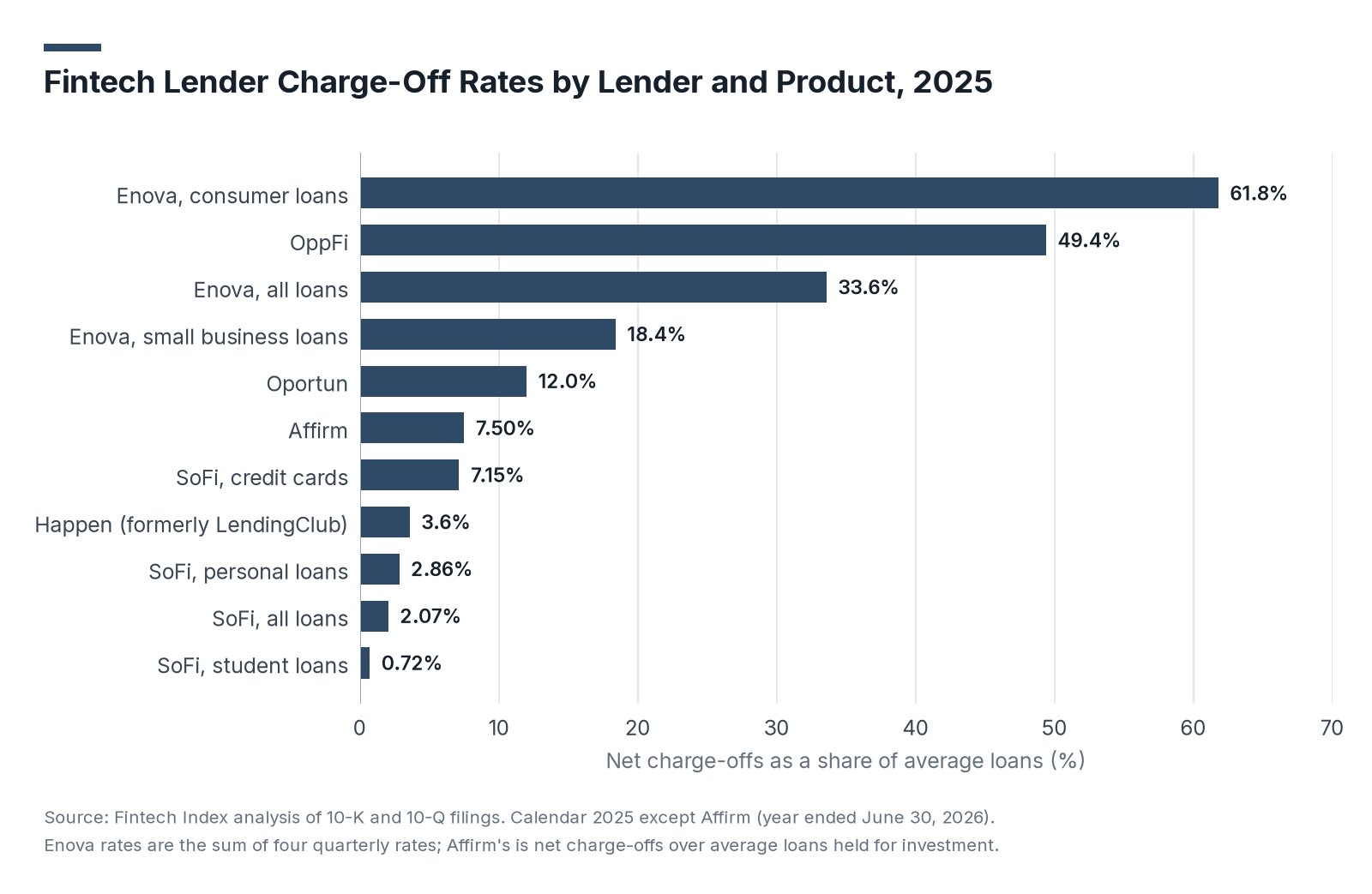
- Taking one company-wide rate per lender, the median is 9.75%, halfway between Affirm's 7.50% and Oportun's 12.0%. The range runs from 2.07% at SoFi to 49.4% at OppFi.
- SoFi's rates differ by more than six percentage points across its products, from 0.72% on student loans to 7.15% on credit cards. SoFi reported no net charge-offs on its home loans in 2025.
- Enova's consumer loans charged off at more than three times the rate of its small business loans in 2025. Enova measures net charge-offs against an average balance that includes accrued fees and interest as well as principal.
- A lender's customer base largely sets how much of its lending goes bad. Company-wide charge-off rates run from 2.07% at SoFi to 49.4% at OppFi, with a median of 9.75%.
Change in Fintech Lender Charge-Off Rates, 2024 to 2025
Looking at two years side by side shows whether these lenders' borrowers are paying back more of what they owe or less.
Most of the lenders' charge-off rates fell from 2024 to 2025, led by SoFi's credit card rate, while Enova's consumer rate rose. A basis point is one hundredth of a percentage point.
| Lender | Product or Segment | Prior-Year Rate | Latest Rate | Change (Basis Points) |
|---|---|---|---|---|
| SoFi | Credit cards | 14.46% | 7.15% | -731 |
| Happen (formerly LendingClub) | All loans held for investment | 5.8% | 3.6% | -220 |
| OppFi | Installment loans | 51.4% | 49.4% | -200 |
| SoFi | Personal loans | 3.54% | 2.86% | -68 |
| SoFi | All loans | 2.63% | 2.07% | -56 |
| Affirm | All loans held for investment | 7.80% | 7.50% | -30 |
| Enova | Small business loans | 18.5% | 18.4% | -10 |
| Oportun | All loans | 12.0% | 12.0% | 0 |
| SoFi | Student loans | 0.64% | 0.72% | +8 |
| Enova | All loans | 33.4% | 33.6% | +16 |
| Enova | Consumer loans | 58.7% | 61.8% | +312 |
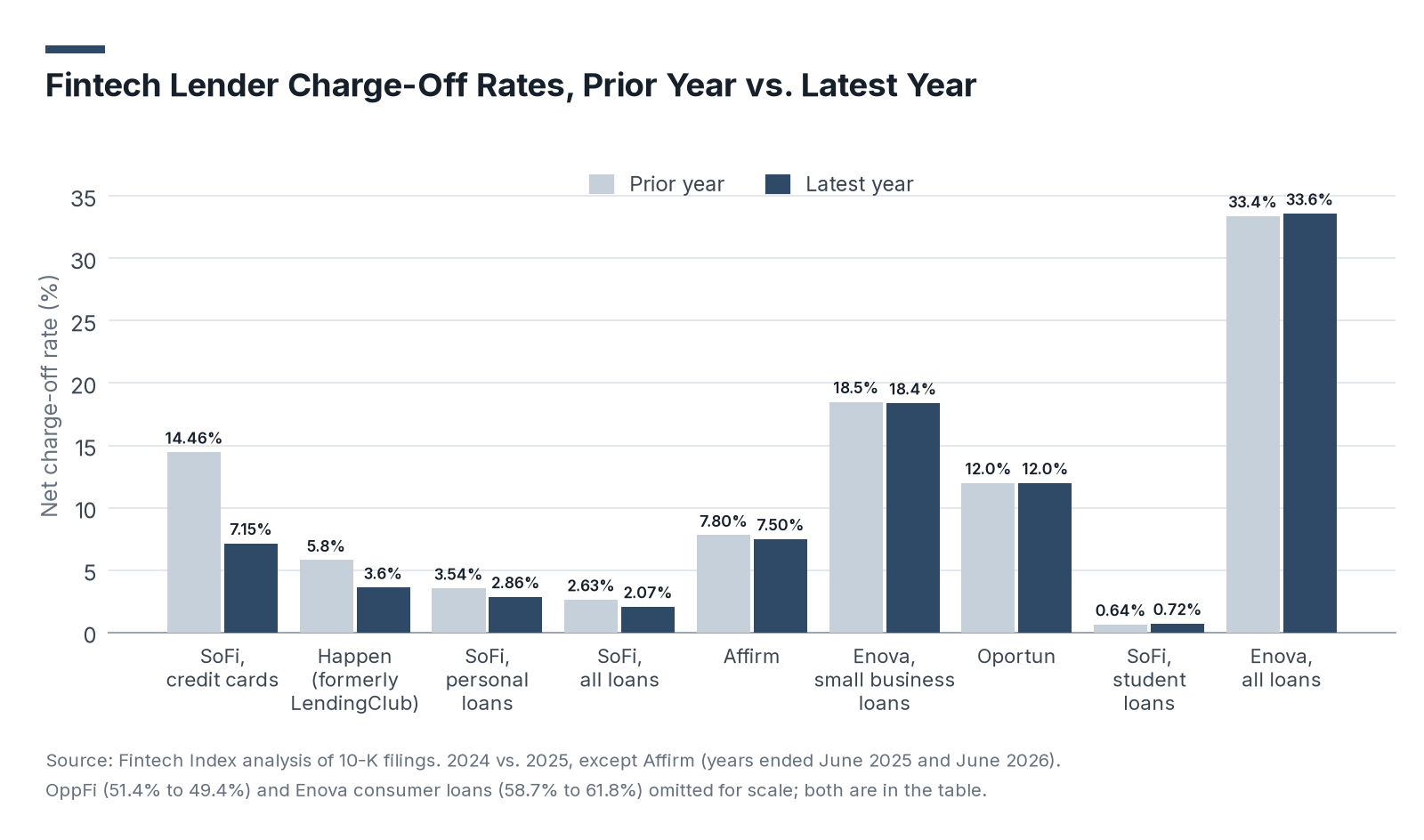
- Seven of the 11 rates fell, Oportun's held at 12.0%, and three rose. Enova's consumer rate rose the most, by 312 basis points to 61.8%.
- SoFi's credit card rate fell by about half, to 7.15% from 14.46%. SoFi's 10-K attributes the drop to lower delinquencies after it tightened underwriting standards, with its credit card delinquency rate at 3.5% at the end of 2025, about 130 basis points lower than a year earlier.
- SoFi's student loan rate rose to 0.72% from 0.64%. The 10-K attributes the rise mainly to its repurchase in 2025 of older student loans that had higher charge-off rates.
- Most lenders improved credit quality in 2025, mainly by lending more carefully. Seven of 11 rates fell, and SoFi's card rate halved to 7.15% after it tightened underwriting.
Fintech Lender Charge-Off Rates in the Second Quarter of 2026
Annual figures run several months behind, so the most recent quarter gives a fresher view of how each lender's loans are doing.
Second-quarter rates are annualized, and the second quarter of 2026 is the latest quarter filed. Affirm is not included because its annual report for the year ended June 30, 2026 does not give charge-offs for the April to June quarter on its own.
| Lender | Product or Segment | Q2 2025 | Q2 2026 | Change (Basis Points) |
|---|---|---|---|---|
| OppFi | Installment loans | 43.5% | 52.3% | +880 |
| Enova | Small business loans | 18.7% | 19.4% | +68 |
| Oportun | All loans | 11.9% | 12.0% | +10 |
| SoFi | Credit cards | 7.70% | 7.65% | -5 |
| SoFi | Personal loans | 2.83% | 2.62% | -21 |
| SoFi | All loans | 2.12% | 1.81% | -31 |
| SoFi | Student loans | 0.94% | 0.61% | -33 |
| Happen (formerly LendingClub) | All loans held for investment, including fair value loans | 3.8% | 3.2% | -60 |
| Enova | All loans | 32.5% | 29.0% | -346 |
| Enova | Consumer loans | 57.9% | 51.1% | -674 |
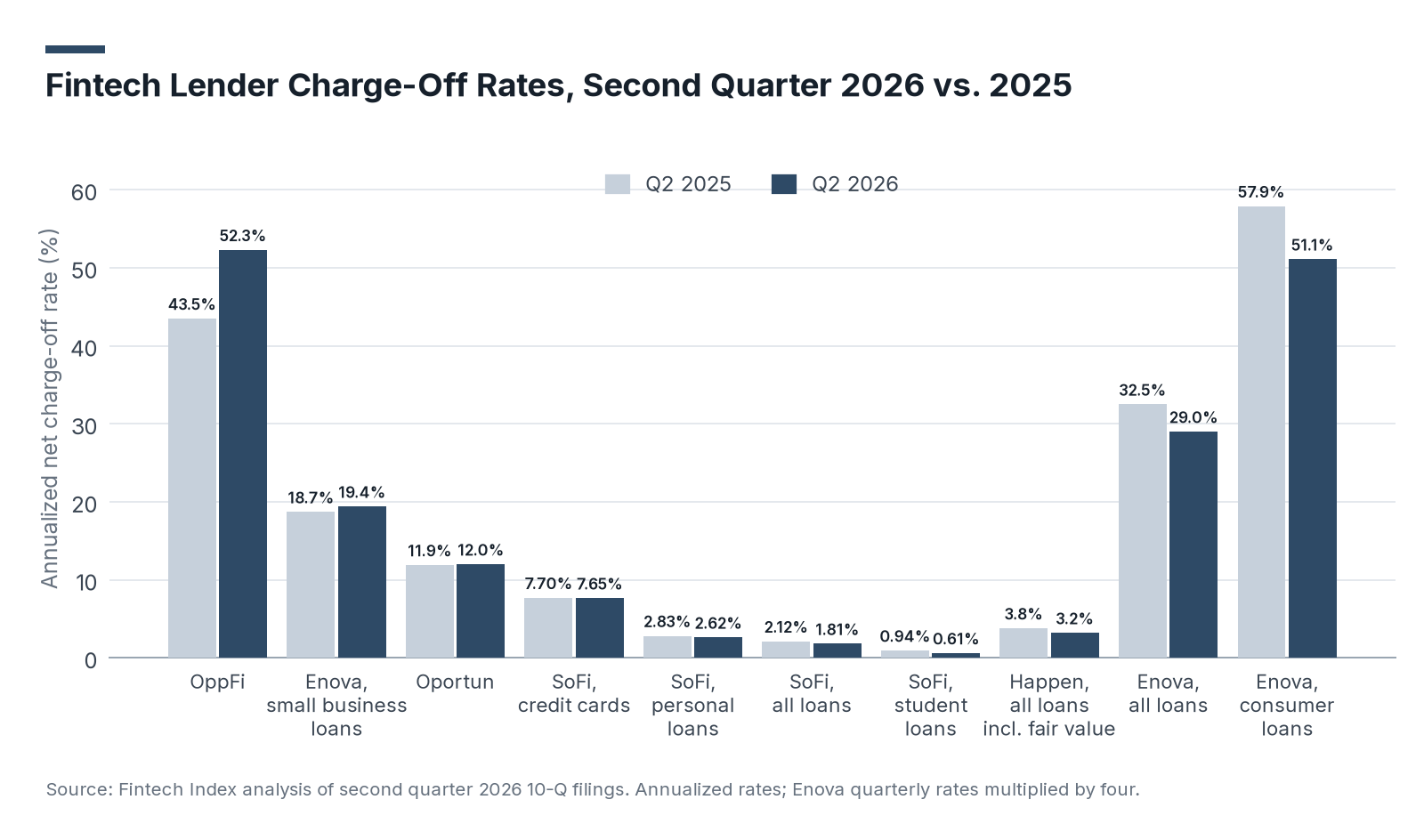
- OppFi's annualized rate rose to 52.3% in the second quarter of 2026 from 43.5% a year earlier. OppFi's 10-Q says the increase came mainly from higher gross charge-offs, which outweighed higher recoveries on loans it had already written off.
- Enova's consumer rate fell to 51.1% from 57.9%, while its small business rate rose to 19.4% from 18.7%.
- Losses at the riskiest lenders rose again in 2026. OppFi's annualized rate climbed to 52.3% from 43.5%. Happen's rate is harder to compare: from the first quarter of 2026 its ratio includes loans carried at fair value, which put the rate at 3.2%, down from 3.8%, while on the old basis it rose to 3.9% from 3.0%.
What Fintech Lender Charge-Off Rate Trends Mean for 2027 and Beyond
How much of a lender's lending goes bad mostly reflects whom it lends to. Prime lenders lose a small share of what they lend, while high-cost lenders write off a large part of their loans each year and have to price their loans to cover it, so the same amount of money can cost very different amounts depending on where you borrow.
Most lenders' losses fell through 2025, helped in SoFi's case by stricter approval standards, but losses at the riskiest end kept rising into 2026. If that pressure spreads, lenders could approve fewer applicants, which would make credit harder to get for borrowers who already have the fewest options.
So if you need a loan, check whether you qualify with a lower-cost lender before you accept a high-cost offer.
Data Collection and Methodology
Before setting one lender's rate against another's, it helps to know how each one decides that a loan is lost.
A net charge-off rate is the share of a loan balance written off in a year, after subtracting what is later recovered. A lender that writes off a net $3 for every $100 of average loans has a rate of 3%. The net charge-off figures come from each company's 2025 annual report on Form 10-K and its quarterly report on Form 10-Q for the second quarter of 2026. Each of the six is publicly traded, makes consumer or small business loans that borrowers apply for online or in an app, and reports net charge-offs together with the average loan balance they are measured against. The full-year rates are each company's own net charge-off ratio where it reports one, broken out by product where the filing does. Affirm's fiscal year ended June 30, 2026, and the others report on the calendar year.
Affirm and Enova do not report a full-year net charge-off ratio. Affirm reports gross charge-offs, recoveries and average loans held for investment, so its rate is charge-offs minus recoveries, divided by the average balance. Enova reports a net charge-off ratio for each quarter only, so its annual figure is the sum of the four quarterly ratios, and its second-quarter figures are the quarterly ratio multiplied by four.
Upstart's and Pagaya's 2025 10-K filings do not report a net charge-off rate. Both companies account for the loans they hold at fair value. MoneyLion stopped filing its own reports after Gen Digital completed its purchase of the company on April 17, 2025.
The six lenders write off loans at different points and measure the rate against different balances, which affects how far the rates can be compared.
- Affirm charges off a loan when its principal is 120 days past due. Its average loan balance for fiscal 2026 was 72.5% interest-bearing loans, 20.8% 0% APR loans and 6.7% Pay-in-X loans, the short interest-free plans paid in a few installments. Its 10-K does not split net charge-offs by product.
- SoFi's personal loan and total ratios leave out $359.9 million in principal of delinquent personal loans that SoFi sold in 2025.
- OppFi measures net charge-offs against the unpaid principal of its loans. Enova's average balance includes accrued fees and interest.
Sources
- Fintech Index, Fintech Lender Charge-Off Rate Study: analysis of 2025 annual reports and second quarter 2026 quarterly reports from six publicly traded online lenders, conducted October 2026.
- Happen (formerly LendingClub) annual report for 2025. LendingClub Corporation, Form 10-K, February 12, 2026.
- Happen quarterly report for the second quarter of 2026. Happen, Inc., Form 10-Q, July 30, 2026.
- SoFi annual report for 2025. SoFi Technologies, Form 10-K, February 17, 2026.
- SoFi quarterly report for the second quarter of 2026. SoFi Technologies, Form 10-Q, August 6, 2026.
- Enova annual report for 2025. Enova International, Form 10-K, February 20, 2026.
- Enova quarterly report for the second quarter of 2026. Enova International, Form 10-Q, July 23, 2026.
- OppFi annual report for 2025. OppFi, Form 10-K, March 12, 2026.
- OppFi quarterly report for the second quarter of 2026. OppFi, Form 10-Q, August 10, 2026.
- Oportun annual report for 2025. Oportun Financial, Form 10-K, February 27, 2026.
- Oportun quarterly report for the second quarter of 2026. Oportun Financial, Form 10-Q, August 6, 2026.
- Affirm annual report for fiscal 2026. Affirm Holdings, Form 10-K, August 27, 2026.
- Upstart annual report for 2025. Upstart Holdings, Form 10-K, February 10, 2026. Used for the reason Upstart is excluded.
- Pagaya annual report for 2025. Pagaya Technologies, Form 10-K, March 2, 2026. Used for the reason Pagaya is excluded.
- MoneyLion current report on completion of its merger with Gen Digital. MoneyLion Inc., Form 8-K, April 17, 2025. Used for the reason MoneyLion is excluded.