Fintech Lender APR Statistics: 2026 Report
How much does an online personal loan cost? Lenders publish only a range, so we compared eight of them with California's records of the loans lenders made.

Online lenders advertise an annual percentage rate (APR) range for their personal loans, and the rate a borrower is offered can fall anywhere in it. States also limit how high rates can go, and California capped interest on mid-sized loans in 2020. Neither the ranges nor the limits show what borrowers are charged once a loan is made.
Our analysts studied the advertised APR ranges, fees and example loans that eight large fintech personal lenders published on their websites on October 13, 2026, along with California's state data on consumer loans made by APR from 2019 to 2024.
In the following sections, we compare the lenders' advertised APR ranges and fees, then look at California loan rates by loan size, including loans under $2,500.
Advertised APR Ranges at Fintech Personal Lenders
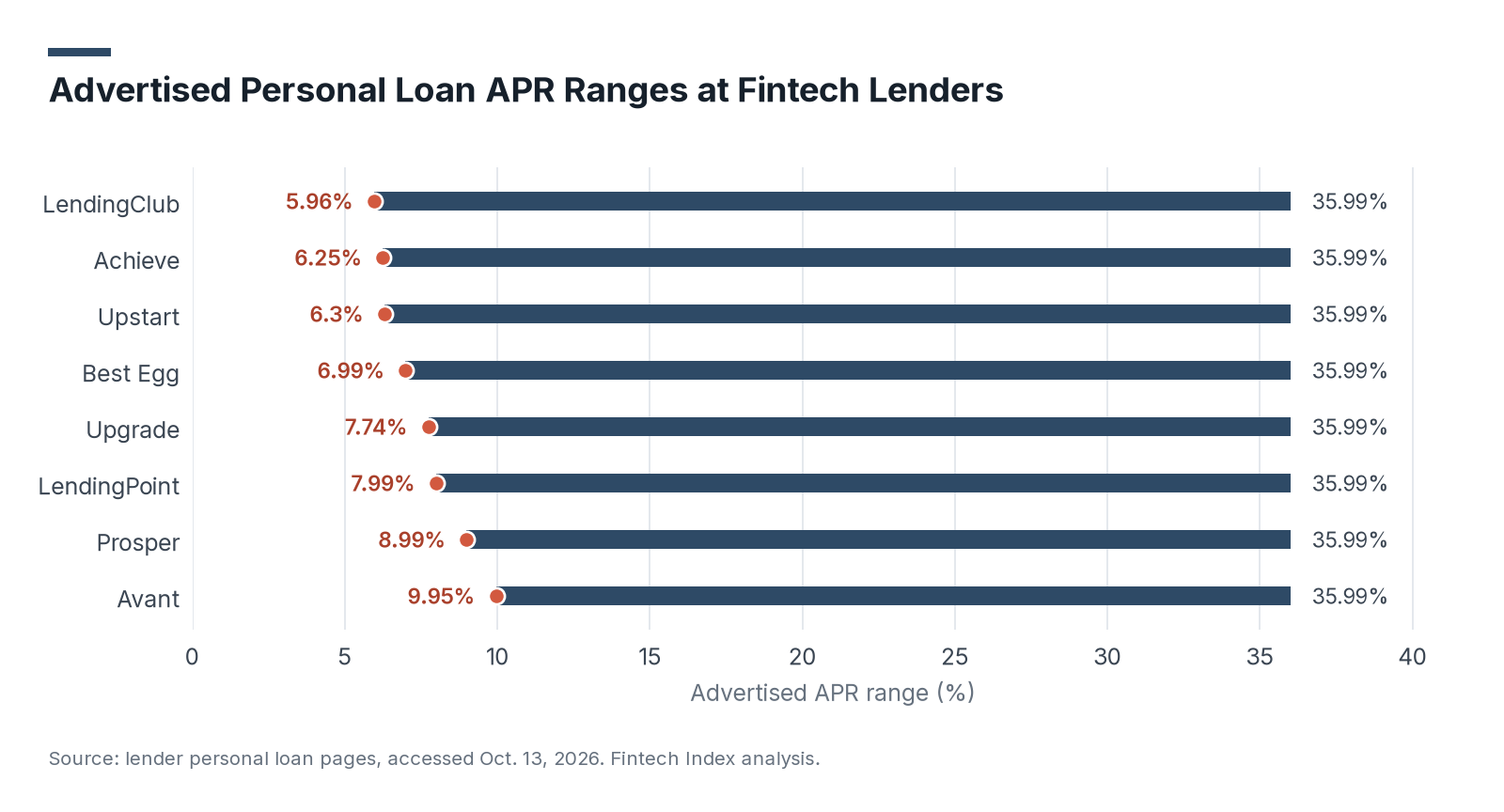
Each lender below publishes an APR range on its personal loan page. The APR includes the origination or administration fee, so it is higher than the interest rate alone.
| Lender | Lowest APR | Highest APR | Origination or Administration Fee | Loan Amounts |
|---|---|---|---|---|
| LendingClub | 5.96% | 35.99% | 0% to 8.00% | $1,000 to $75,000 |
| Achieve | 6.25% | 35.99% | 1.99% to 9.99% | $5,000 to $50,000 |
| Upstart | 6.3% | 35.99% | Not stated as a range | $1,000 to $75,000 |
| Best Egg | 6.99% | 35.99% | 0.99% to 9.99% | $2,000 to $50,000 |
| Upgrade | 7.74% | 35.99% | 1.85% to 9.99% | $1,000 to $50,000 |
| LendingPoint | 7.99% | 35.99% | 10% in its published example | $1,000 to $36,500 |
| Prosper | 8.99% | 35.99% | 1% to 9.99% | $2,000 to $50,000 |
| Avant | 9.95% | 35.99% | Up to 9.99% | $2,000 to $35,000 |
- All eight lenders cap their APR at 35.99%, just under the 36% level used in many state rate caps and the Military Lending Act.
- Six of the eight charge an upfront fee of up to 9.99% or 10% of the loan amount, which most of them deduct from the money the borrower receives.
- The lowest advertised APRs run from 5.96% to 9.95%, but the example loans the lenders publish carry APRs of 17.59% at Upgrade, 18.40% at LendingClub, 20.02% and 24.19% at Prosper, 23.37% at Upstart, 26.59% at LendingPoint and 29.95% at Avant.
- Oportun, which does not publish an APR range, gives an example of a $3,333 loan with a 10% administrative fee that carries a 35.95% APR.
California Consumer Loan APRs by Loan Size
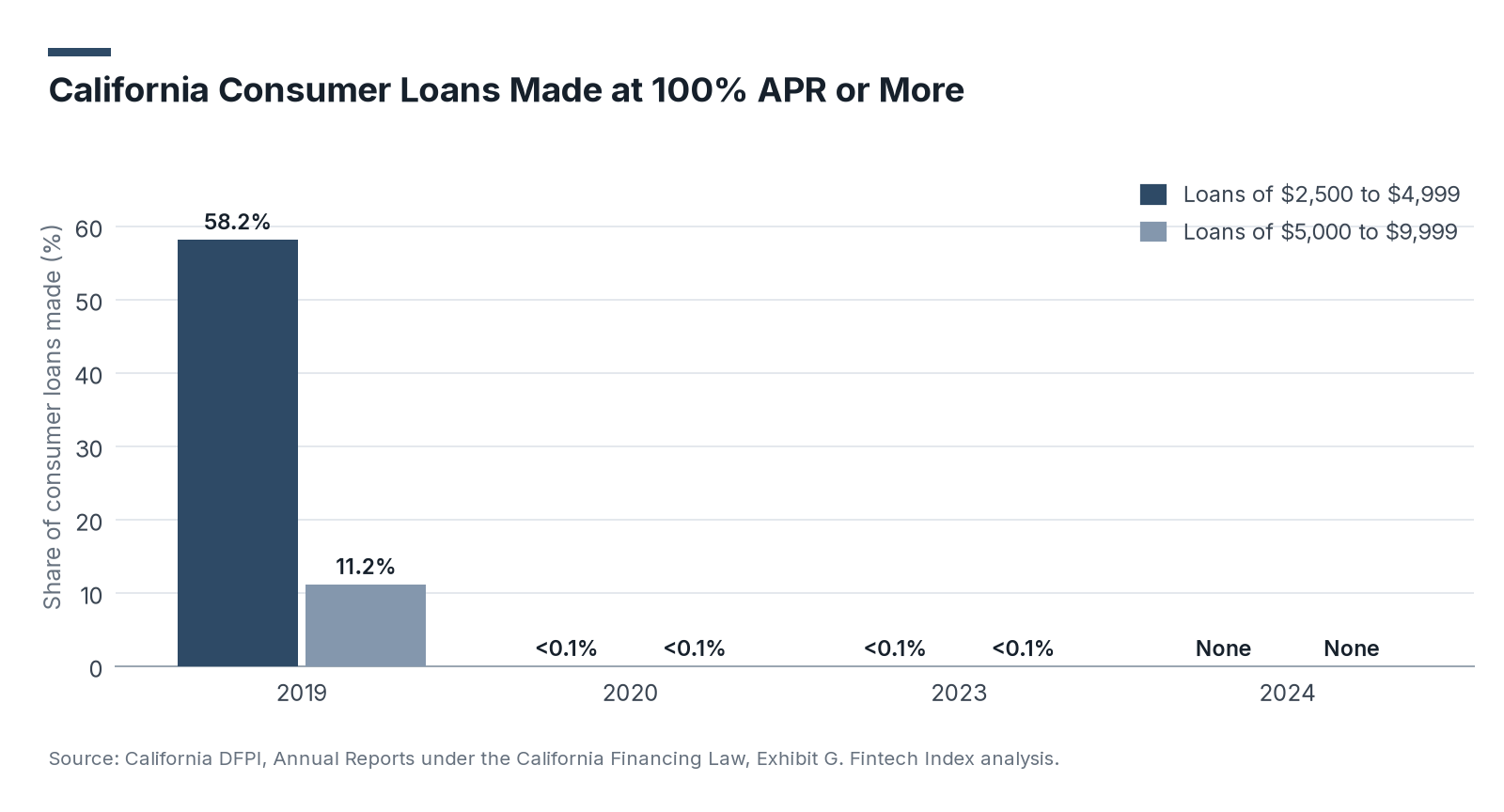
California requires every licensed finance lender, including online lenders, to report loans made by APR band. Since January 1, 2020, interest on loans of $2,500 to $9,999 has been capped at 36% a year plus the federal funds rate.
| Year | Loans Made | 35% to 39.99% APR | 40% to 69.99% APR | 70% to 99.99% APR | 100% APR or More |
|---|---|---|---|---|---|
| 2019 | 597,717 | 23.6% | 3.9% | 7.2% | 58.2% |
| 2020 | 110,131 | 74.3% | 1.7% | Under 0.1% | Under 0.1% |
| 2023 | 165,174 | 62.8% | 6.1% | Under 0.1% | Under 0.1% |
| 2024 | 130,089 | 50.6% | 11.4% | 0% | 0% |
| Year | Loans Made | 35% to 39.99% APR | 40% to 69.99% APR | 70% to 99.99% APR | 100% APR or More |
|---|---|---|---|---|---|
| 2019 | 258,733 | 35.8% | 4.3% | 7.1% | 11.2% |
| 2020 | 139,638 | 58.9% | Under 0.1% | Under 0.1% | Under 0.1% |
| 2023 | 157,989 | 77.4% | 4.1% | Under 0.1% | Under 0.1% |
| 2024 | 92,907 | 64.4% | 10.2% | 0% | 0% |
- In 2019, 347,748 loans of $2,500 to $4,999, or 58.2%, carried an APR of 100% or more. None did in 2024.
- The number of $2,500 to $4,999 loans made fell 78.2%, from 597,717 in 2019 to 130,089 in 2024.
- Half of all $2,500 to $4,999 loans in 2024, 50.6%, were priced at 35% to 39.99% APR, at or just below the cap.
California Loans Under $2,500
Loans under $2,500 are not covered by the 2020 rate cap but follow California's older small-loan rate schedule. Lenders made 58 times as many of them in 2024 as in 2019. California's financial regulator says the growth came mainly from buy now, pay later loans, which surged in 2020 and made up 98% of all consumer loans its licensees made in 2024.
| Year | Loans Made | Principal | Under 15% APR | 40% APR or More |
|---|---|---|---|---|
| 2019 | 762,034 | $438.5 million | 28.1% | 40.9% |
| 2020 | 11,294,223 | $1.37 billion | 97.0% | 1.0% |
| 2023 | 39,054,856 | $4.50 billion | 97.0% | Under 0.1% |
| 2024 | 44,469,075 | $4.92 billion | 97.3% | Under 0.1% |
- California licensees made 44.5 million loans under $2,500 in 2024, against 762,034 in 2019.
- In 2024, 97.3% of these loans carried an APR under 15%, against 28.1% in 2019.
What Fintech Lender APR Trends Mean for 2027 and Beyond
Every large online lender in this report stops just below 36% APR, so the price a borrower is offered depends mostly on their credit and on the upfront fee, which usually comes out of the money they receive. Since California capped interest on mid-sized loans, loans of that size priced at 100% APR or more have disappeared from state-licensed lenders, and far fewer of those loans are made.
That ceiling can move. California's cap on loans of $2,500 to $9,999 is 36% plus the federal funds rate, so each rate cut by the Federal Reserve lowers the most a lender can charge on those loans, and each increase raises it. Where that ceiling sits decides what borrowers with weaker credit pay and how many of these loans lenders are willing to make.
So if you are shopping for a personal loan, check your rate with several lenders and compare the APR each one offers you, along with how much of the loan its fee will take, before you accept.
Data Collection and Methodology
The Fintech Index research team collected the APR ranges, fees and loan amounts published on each lender's personal loan page on October 13, 2026, rechecked on October 17, 2026, and the loans-by-rate tables (Exhibit G) from the California Department of Financial Protection and Innovation's annual reports under the California Financing Law for 2019, 2020, 2023 and 2024.
Lender APRs are the advertised ranges and depend on credit, state, loan amount and term. Ranges do not show how many loans are made at each rate. Example APRs are the representative example loans each lender publishes with a stated fee; Best Egg's examples give an APR without a fee and are left out. SoFi, OppLoans, Universal Credit, Happy Money and Reach were left out because their pages did not show an APR range, and Oportun publishes only an example APR. The California figures cover all consumer loans made or refinanced by lenders licensed under the California Financing Law, which includes online lenders and other finance companies but not banks. Shares divide DFPI loan counts in each APR band by all loans made in the same size class, including the small number made under the step and alternate rates listed separately in the report. Loan counts are self-reported and unaudited. The 2020 cap on $2,500 to $9,999 loans is set by California Financial Code section 22304.5.
Sources
- Fintech Index, Fintech Lender APR Study: analysis of advertised APR ranges from eight fintech personal lenders and California Financing Law loan data by APR and loan size, 2019 to 2024, conducted October 2026.
- California DFPI, California Financing Law Reports
- California DFPI, 2024 Annual Report under the California Financing Law
- California DFPI, 2019 Annual Report under the California Financing Law
- California DFPI, 2020 Annual Report under the California Financing Law
- California Financial Code section 22304.5
- Upstart, Personal Loans
- LendingClub, Personal Loans
- Best Egg, Personal Loans
- Avant, Personal Loans
- Upgrade, Personal Loans
- Prosper, Personal Loans
- LendingPoint, Personal Loans
- Achieve, Personal Loans
- Oportun, Personal Loans