Crypto Exchange Take Rates: 2026 Report
How much does a crypto exchange keep from each trade? We worked it out from the revenue and trading volume in each publicly traded exchange's own filings.

Crypto trading platforms earn transaction revenue on the trades their customers make. But the share of each trade they keep varies widely by platform.
Our analysts studied six publicly traded companies that run crypto trading platforms: Coinbase, Robinhood, Gemini, Bullish, eToro and Coincheck. We used their filings for 2025 and 2024.
In the following sections, we compare take rates by company, look inside Gemini's rates, show the change since 2024, and track Robinhood's rate by quarter.
Crypto Exchange Take Rates by Company
Coinbase reports consumer and institutional revenue and volume separately, so it has three take rates: consumer, institutional and all transactions.
| Company | Revenue Line Used | Transaction Revenue | Trading Volume | Take Rate |
|---|---|---|---|---|
| Coincheck (year ended March 2026) | Company-reported average Marketplace spread | Not used (booked gross) | ¥313B (Marketplace) | 3.28% |
| Coinbase, consumer | Consumer transaction revenue | $3,322.8M | $239B | 1.390% |
| eToro | Crypto net trading contribution | $155M | $15.7B (derived) | 0.986% |
| Robinhood | Crypto transaction-based revenue | $901M | $243B | 0.371% |
| Coinbase, all transactions | Total transaction revenue | $4,055.4M | $1,221B | 0.332% |
| Gemini | Transaction revenue | $98.0M | $52.7B | 0.186% |
| Coinbase, institutional | Institutional transaction revenue | $479.7M | $982B | 0.049% |
| Bullish | Company-reported average trading spread | Not used (spread reported) | $796.2B | 0.016% |
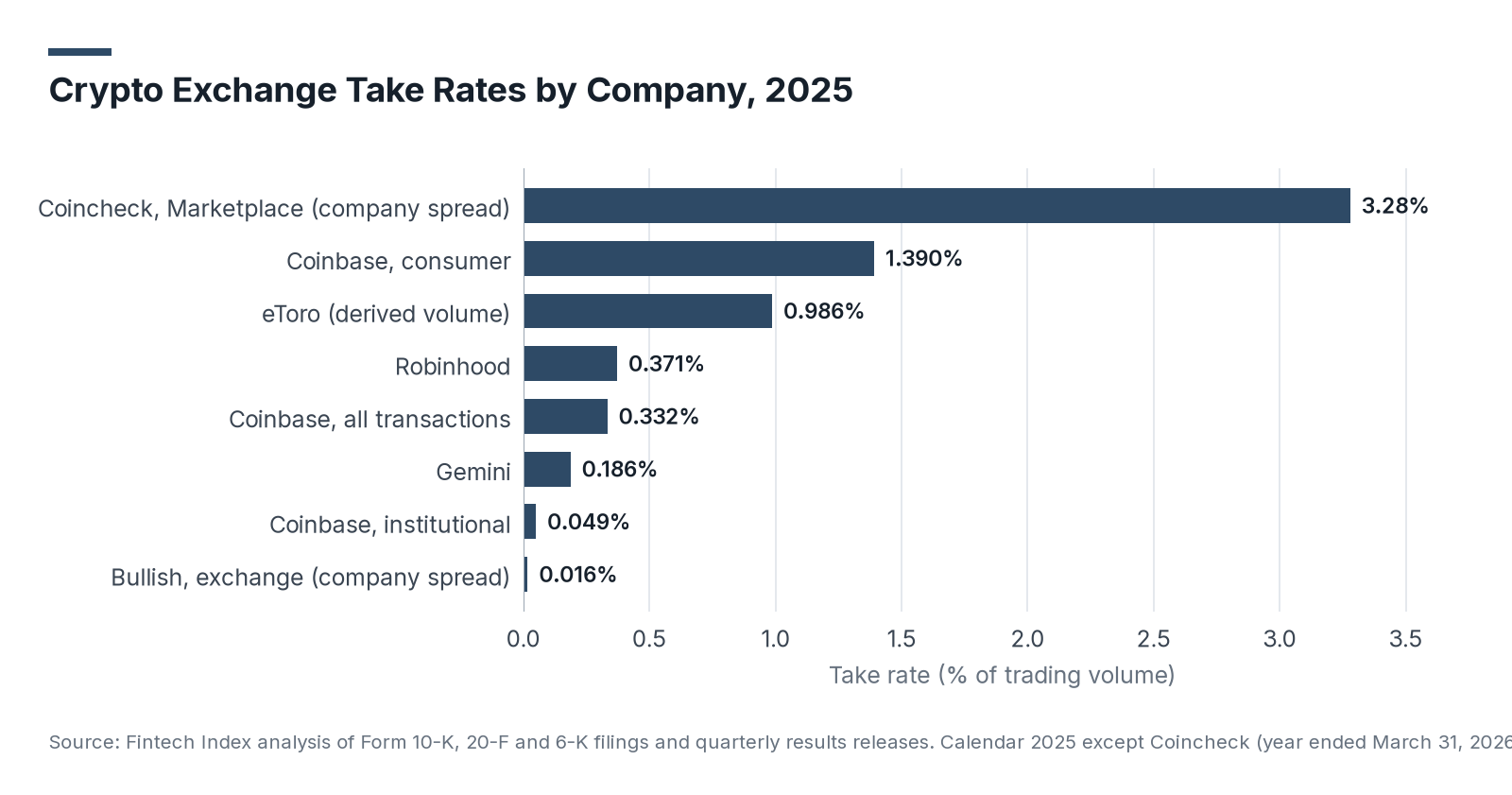
- Across the six companies, using Coinbase's all-transaction rate of 0.332%, the median take rate is 0.351%, halfway between Coinbase and Robinhood's 0.371%. The range runs from 0.016% at Bullish to 3.28% at Coincheck's Marketplace business.
- Coinbase kept 1.390% of consumer trading volume and 0.049% of institutional volume in 2025, so a dollar of consumer trading produced about 28 times as much revenue as a dollar of institutional trading. Consumers made up $239 billion of Coinbase's $1,221 billion in volume and $3,322.8 million of its $4,055.4 million in transaction revenue.
- Coincheck sets the price at which it buys from and sells to customers on its Marketplace platform. Its 20-F says the spread generally falls between 0.1% and 5.0% of a trade's value and averaged 3.28% in the year ended March 2026.
- What a trader pays depends heavily on how they trade. Coinbase kept 1.390% of consumer volume but 0.049% of institutional volume, and the median rate across six companies is 0.351%.
Gemini Crypto Exchange Take Rates by Customer Type and Asset
Gemini splits its trading volume between retail and institutional customers and reports exchange revenue by crypto asset, which shows how its take rate varies with what customers trade.
| Asset | 2025 Exchange Revenue | 2025 Volume | 2025 Take Rate | 2024 Take Rate |
|---|---|---|---|---|
| Bitcoin | $43M | $24.3B | 0.177% | 0.169% |
| Ether | $16M | $15.8B | 0.101% | 0.234% |
| XRP | $10M | $3.7B | 0.270% | 0.571% |
| Other assets | $24M | $8.9B | 0.270% | 0.515% |
- Institutional customers accounted for $46.0 billion of Gemini's $52.7 billion in 2025 volume, up from $31.6 billion of $38.6 billion in 2024. Retail volume fell to $6.7 billion from $7.0 billion, and Gemini's 10-K says retail revenue fell $13.0 million as a result.
- Gemini's growth came from customers who pay much less per trade. Institutional volume rose to $46.0 billion while retail fell to $6.7 billion.
- Ether volume on Gemini's exchange roughly doubled to $15.8 billion while ether revenue fell to $16 million from $18 million, cutting the rate on ether trades from 0.234% to 0.101%.
Change in Crypto Exchange Take Rates, 2024 to 2025
Six of the seven take rates fell from 2024 to 2025, and only Coinbase's institutional rate rose. Coincheck's figures are for fiscal years ended in March. Bullish is not included because its monthly metrics filings give average trading spreads from January 2025 only.
| Company | 2024 Take Rate | 2025 Take Rate | Change (Basis Points) | Volume Growth | Revenue Growth |
|---|---|---|---|---|---|
| Coincheck (years ended March) | 3.49% | 3.28% | -21.0 | n/a | n/a |
| Coinbase, consumer | 1.531% | 1.390% | -14.1 | 6.7% | -3.1% |
| eToro | 1.119% | 0.986% | -13.2 | -8.9% (derived) | -19.7% |
| Gemini | 0.257% | 0.186% | -7.1 | 36.5% | -1.1% |
| Robinhood | 0.438% | 0.371% | -6.7 | 70.0% | 43.9% |
| Coinbase, all transactions | 0.335% | 0.332% | -0.3 | 2.7% | 1.7% |
| Coinbase, institutional | 0.036% | 0.049% | +1.3 | 1.8% | 38.8% |
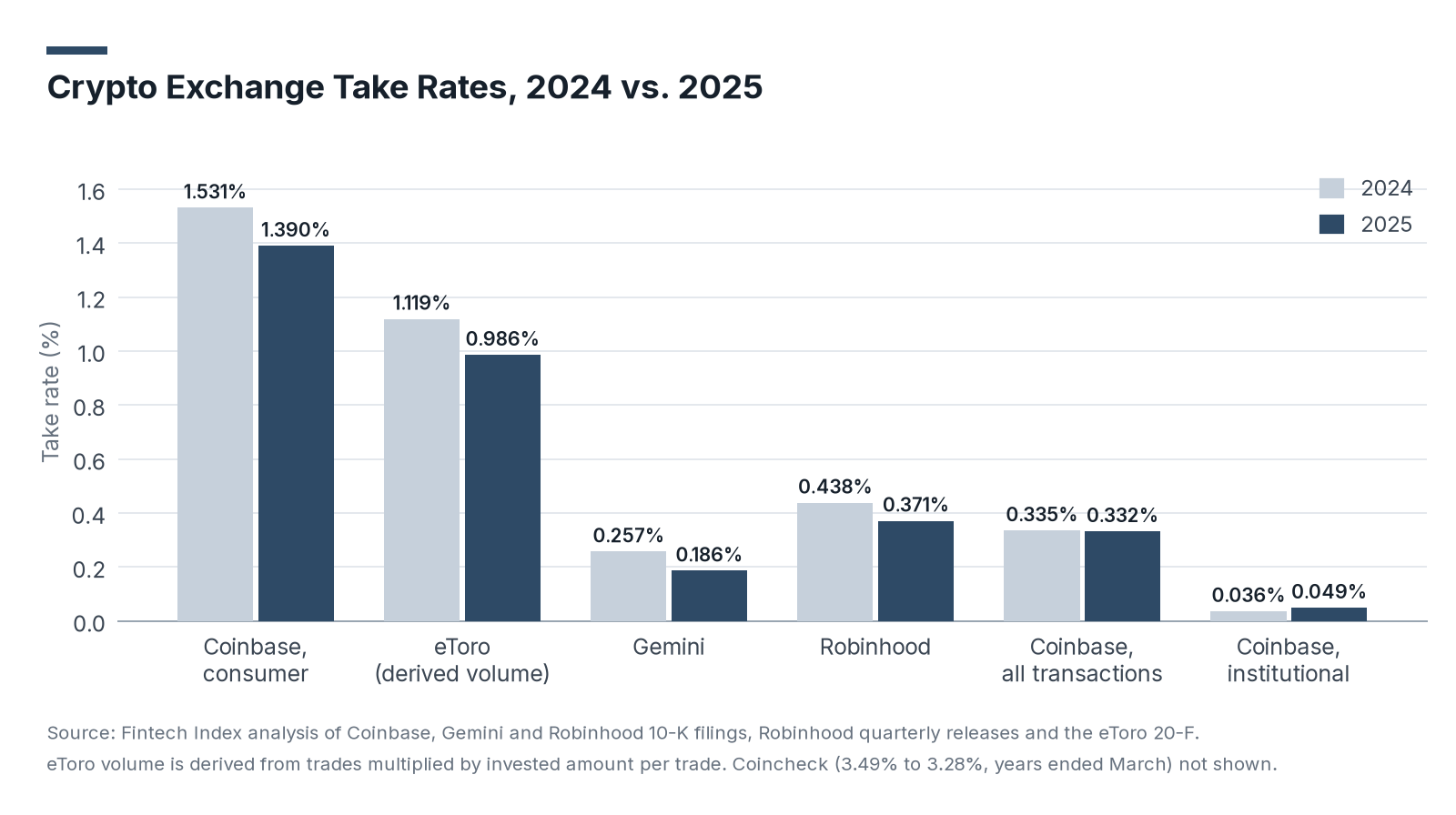
- Coinbase's institutional rate rose from 0.036% to 0.049%. Its 2025 institutional revenue includes $152.0 million from derivatives trading, which the 10-K attributes mainly to Coinbase's August 2025 purchase of the Deribit exchange, while its institutional volume figure counts spot trades only.
- Coinbase's 10-K says a lower blended fee rate cut consumer transaction revenue by $384.4 million in 2025, mainly because more consumer volume came from Advanced traders and Coinbase One subscribers, who pay lower fees than users of its basic Simple trading screen. Higher consumer volume, up 6.7% by the figures above (7% in the 10-K), added $277.0 million.
- Higher volume no longer guarantees higher revenue at crypto exchanges. Gemini's volume grew 36.5% while its transaction revenue fell 1.1%.
Robinhood Crypto Take Rate by Quarter
Robinhood bought Bitstamp, its first crypto exchange, in 2025, and its crypto take rate in every quarter since has stayed below its peak of 0.548% in the first quarter of 2025.
Its quarterly releases have counted Bitstamp's volume in its crypto notional volume since the purchase closed on June 2, 2025.
| Quarter | Crypto Revenue | Crypto Notional Volume | Of Which Bitstamp | Take Rate |
|---|---|---|---|---|
| Q1 2024 | $126M | $36.0B | None | 0.350% |
| Q2 2024 | $81M | $21.5B | None | 0.377% |
| Q3 2024 | $61M | $14.4B | None | 0.424% |
| Q4 2024 | $358M | $71.0B | None | 0.504% |
| Q1 2025 | $252M | $46B | None | 0.548% |
| Q2 2025 | $160M | $35B | $7B | 0.457% |
| Q3 2025 | $268M | $80B | $40B | 0.335% |
| Q4 2025 | $221M | $82B | $48B | 0.270% |
| Q1 2026 | $134M | $66B | $42B | 0.203% |
| Q2 2026 | $100M | $40B | $22B | 0.250% |
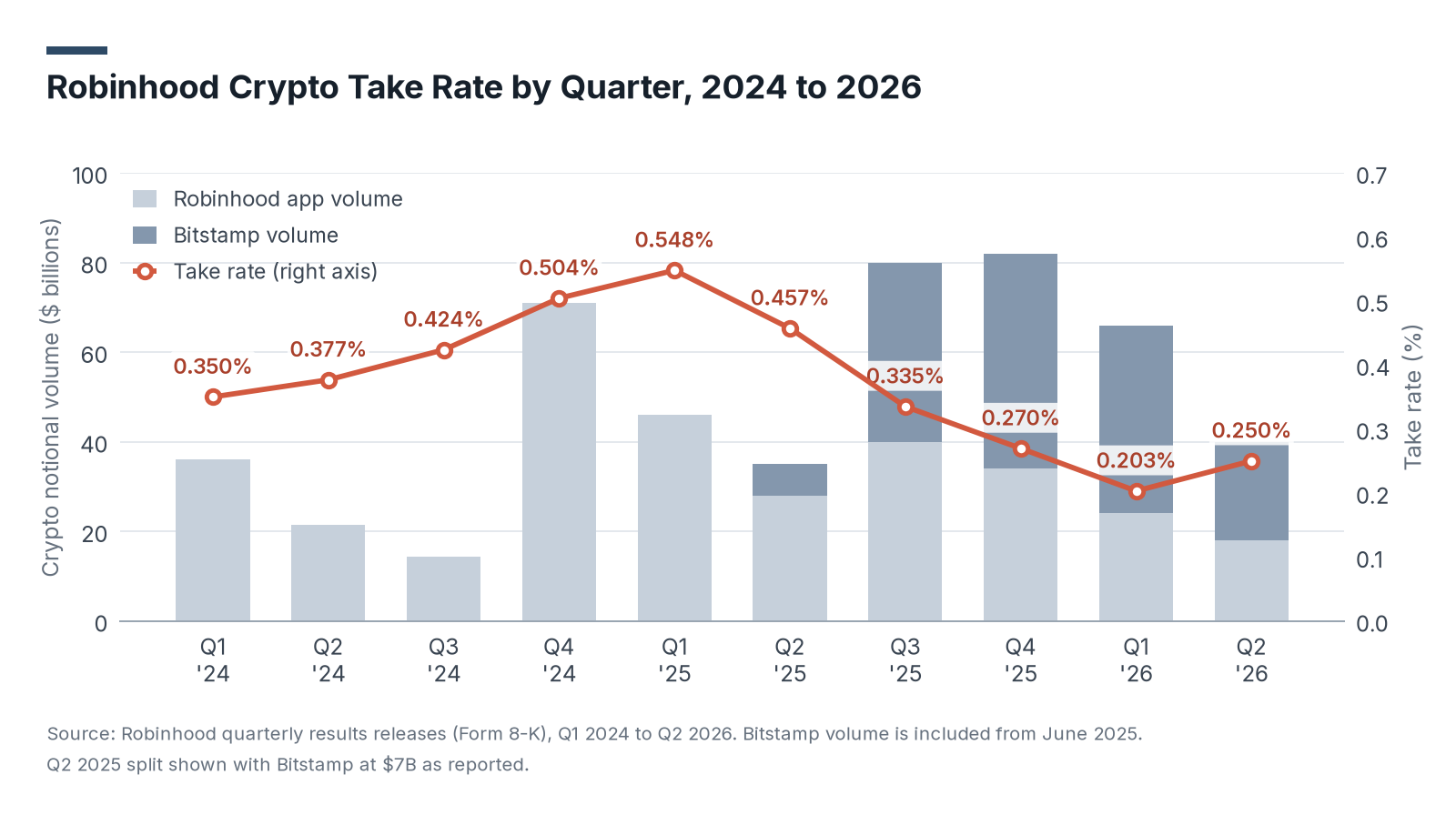
- Robinhood's crypto take rate peaked at 0.548% in the first quarter of 2025 and fell to 0.203% in the first quarter of 2026, when Bitstamp handled $42 billion of the $66 billion total.
- Volume on the Robinhood app itself fell from $46 billion in the first quarter of 2025 to $18 billion in the second quarter of 2026, when Bitstamp handled 55% of Robinhood's total crypto volume, down from 64% in the first quarter of 2026.
- Robinhood's take rate has fallen as its own app has lost volume to Bitstamp. The rate dropped from 0.548% to 0.203% between the first quarters of 2025 and 2026. Robinhood's 2025 10-K credits the year's crypto revenue growth mainly to higher rebates from crypto market makers, which pay a fixed percentage of each order's value, and to the Bitstamp purchase.
What Crypto Exchange Take Rate Trends Mean for 2027 and Beyond
For most people who buy crypto, the cost of a trade is set less by the exchange they pick than by the screen they trade on. The simple buy button in a consumer app is the priciest way to trade, while large clients and advanced screens pay a small fraction of that, so the same purchase can cost very different amounts depending on how it is placed.
Exchanges are earning less on each dollar traded as more of their business comes from big clients and cheaper tiers. To hold on to revenue, they have to either find income beyond trading fees or keep everyday customers on the pricier consumer screens, and the path each one takes decides what ordinary traders pay.
So if you buy crypto regularly, compare what the basic buy button costs with the exchange's advanced trading screen before your next purchase.
Data Collection and Methodology
A take rate is the share of the dollar value of trades that a platform keeps as revenue. An exchange that earns $1 on $1,000 of trades has a take rate of 0.10%. Each figure comes from a company's annual report, monthly metrics filings or quarterly results releases. All six companies are publicly traded. Five report crypto trading volume, or a company-calculated fee rate on that volume, for the same period as their revenue, and eToro reports crypto trade counts and the average amount per trade, from which its volume is derived. Each take rate is transaction revenue divided by trading volume, for calendar 2025 and calendar 2024. Coincheck's fiscal year ended March 31, 2026.
Four companies do not report annual crypto revenue and volume in a form that can be divided directly. Robinhood reports crypto volume only in its quarterly releases, in whole billions of dollars, and revenue in whole millions, so its 2025 volume of $243 billion and revenue of $901 million are sums of four quarters. Bullish reports trading volume and its own "average trading spread," defined as commissions divided by volume, in monthly filings, and its 2025 rate is the average of the 12 monthly spreads, weighted by each month's volume. Its spread definition includes rebates and changes in the fair value of perpetual futures. eToro does not report crypto trading volume in dollars, so its volume is its quarterly count of crypto trades multiplied by its average invested amount per trade, and its take rate is its crypto net trading contribution divided by that volume. Coincheck books the full value of crypto it sells to customers as revenue, so its take rate is the average spread it reports for its Marketplace business.
The companies also count revenue and volume in different ways, which affects how far their rates can be compared. Coinbase changed its volume definition in the fourth quarter of 2025 to add half of the value of spot trades it routes to outside venues, and it recast prior years on the same basis. Its transaction revenue includes "other transaction revenue" of $252.9 million in 2025.
eToro's crypto net trading contribution is revenue from crypto assets, plus net trading income from crypto derivatives, less the cost of the crypto it sells, excluding staking and blockchain rewards. Its 20-F reports 57 million crypto trades in 2025. Its quarterly counts, reported in rounded millions, add up to 58 million, and the invested amount per trade ranged from $239 to $300 a quarter.
Kraken is not included because its parent company, Payward, is not publicly traded, and CoinDesk reported in September 2026 that Payward had pushed its planned IPO to mid-2027 at the earliest.
Sources
- Fintech Index, Crypto Exchange Take Rate Study: analysis of annual filings published in 2026 and quarterly and monthly filings from May 2024 to July 2026 from six publicly traded crypto trading companies, conducted October 2026.
- Coinbase annual report for 2025. Coinbase Global, Form 10-K, February 12, 2026.
- Robinhood annual report for 2025. Robinhood Markets, Form 10-K, February 18, 2026.
- Robinhood first quarter 2024 results. Robinhood Markets, Form 8-K, May 8, 2024.
- Robinhood second quarter 2024 results. Robinhood Markets, Form 8-K, August 7, 2024.
- Robinhood third quarter 2024 results. Robinhood Markets, Form 8-K, October 30, 2024.
- Robinhood fourth quarter and full year 2024 results. Robinhood Markets, Form 8-K, February 12, 2025.
- Robinhood first quarter 2025 results. Robinhood Markets, Form 8-K, April 30, 2025.
- Robinhood second quarter 2025 results. Robinhood Markets, Form 8-K, July 30, 2025.
- Robinhood third quarter 2025 results. Robinhood Markets, Form 8-K, November 5, 2025.
- Robinhood fourth quarter and full year 2025 results. Robinhood Markets, Form 8-K, February 10, 2026.
- Robinhood first quarter 2026 results. Robinhood Markets, Form 8-K, April 28, 2026.
- Robinhood second quarter 2026 results. Robinhood Markets, Form 8-K, July 29, 2026.
- Gemini annual report for 2025. Gemini Space Station, Form 10-K, March 31, 2026.
- Bullish monthly metrics report for February 2026. Bullish, Form 6-K, March 6, 2026. Includes monthly volume and average trading spread for January 2025 to February 2026.
- Bullish annual report for 2025. Bullish, Form 20-F, March 10, 2026. Used to confirm that the annual report does not give trading volume.
- eToro annual report for 2025. eToro Group, Form 20-F, March 2, 2026. Includes quarterly crypto trade counts, invested amount per crypto trade and crypto net trading contribution for the first quarter of 2023 through the fourth quarter of 2025.
- Coincheck annual report for the year ended March 31, 2026. Coincheck Group, Form 20-F, June 29, 2026.
- Kraken parent Payward pushes IPO back to mid-2027 at earliest. CoinDesk, September 2, 2026. Used for Payward's IPO plans.