BNPL Default Rates: 2026 Report
How often do buy now, pay later loans go unpaid? The lenders don't say, so we worked it out from their own numbers.

Buy now, pay later (BNPL) lenders finance purchases that shoppers pay off in installments, and some of those loans are never repaid. How often that happens differs from one lender to the next.
Our analysts studied five publicly traded BNPL lenders: Affirm, Block (Afterpay), Klarna, Sezzle and Zip. We took their credit loss, delinquency and allowance figures from filings published by October 8, 2026.
In the following sections, we compare write-offs, late payments and loss reserves by lender, set them against CFPB data, and explain how each lender counts losses.
BNPL Default Rates as a Share of Purchase Volume
Write-offs and loss provisions took a larger share of purchase volume at Sezzle in 2025 than at Zip, Affirm or Klarna in their latest fiscal years. Net charge-offs are the loans a lender writes off as unpaid, minus what it later recovers. A provision is the expense a lender books for losses it expects on loans made during the period.
| Lender | Fiscal Year | Net Charge-Offs as % of GMV | Prior Year | Provision as % of GMV | Prior Year |
|---|---|---|---|---|---|
| Sezzle | 2025 | 2.21% | 1.62% | 2.27% | 2.17% |
| Zip (net bad debts, % of total transaction value) | Ended June 2026 | 1.77% | 1.52% | Not reported on this basis | Not reported on this basis |
| Affirm | Ended June 2026 | 1.22% | 1.36% | 1.55% | 1.60% |
| Klarna | 2025 | Not reported | Not reported | 0.62% (company figure 0.63%) | 0.47% |
| Block (Afterpay) | 2025 | No GMV reported | No GMV reported | No GMV reported | No GMV reported |
| CFPB, six large lenders, pay-in-four loans only (dollar amount charged off, % of GMV) | 2023 | 0.92% | 1.71% (2022) | Not reported | Not reported |
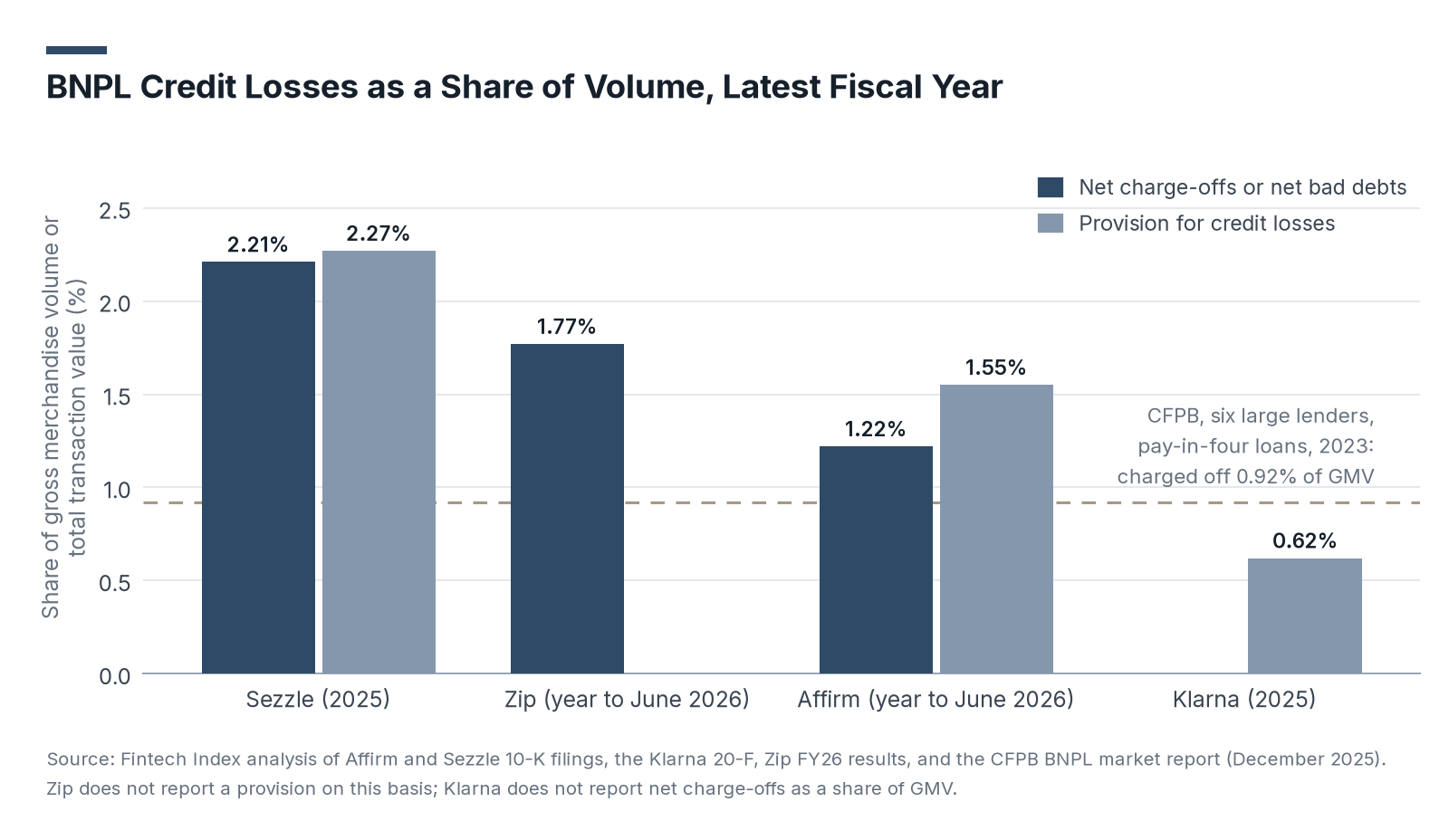
- Among the three lenders that report write-offs against volume, the BNPL default rate ranged from 1.22% at Affirm to 2.21% at Sezzle, and the median was Zip's 1.77%. All three were above the 0.92% of GMV that the six large lenders in the CFPB's survey charged off on pay-in-four loans in 2023.
- Sezzle's net charge-offs rose to $86.9 million in 2025 from $41.2 million in 2024, while its GMV grew to $3,940.4 million from $2,540.2 million. Its rate rose 58 basis points, to 2.21%. A basis point is one hundredth of a percentage point.
- BNPL losses now run above the CFPB's last industry figure. Affirm, Zip and Sezzle wrote off 1.22% to 2.21% of volume, against 0.92% in the CFPB's 2023 survey. Sezzle's rate rose 58 basis points.
- Klarna's provision rose to $794 million in 2025 from $495 million. Its 20-F attributes the higher rate mainly to growth in its Fair Financing product, a longer-term loan that carries higher upfront provisions than its Pay Later plans, and says Fair Financing GMV rose 123%. Klarna also says its credit losses were below 0.2% of GMV in its most mature markets.
BNPL Delinquency Rates by Lender
The share of loans past due rose at Sezzle and Block (Afterpay) in the first half of 2026 and edged up at Affirm in its fiscal year to June 2026. A lender's delinquency rate is the share of its loan balance that is past due.
| Lender | Past-Due Threshold | Prior Year-End | Latest Year-End | June 30, 2026 |
|---|---|---|---|---|
| Sezzle | 29 or more days | 7.08% | 6.39% | 7.15% |
| Block (Afterpay) | 61 or more days | 4.07% | 4.50% | 5.58% |
| Affirm | 30 or more days | 2.46% (June 2025) | 2.51% (June 2026) | Same as latest year-end |
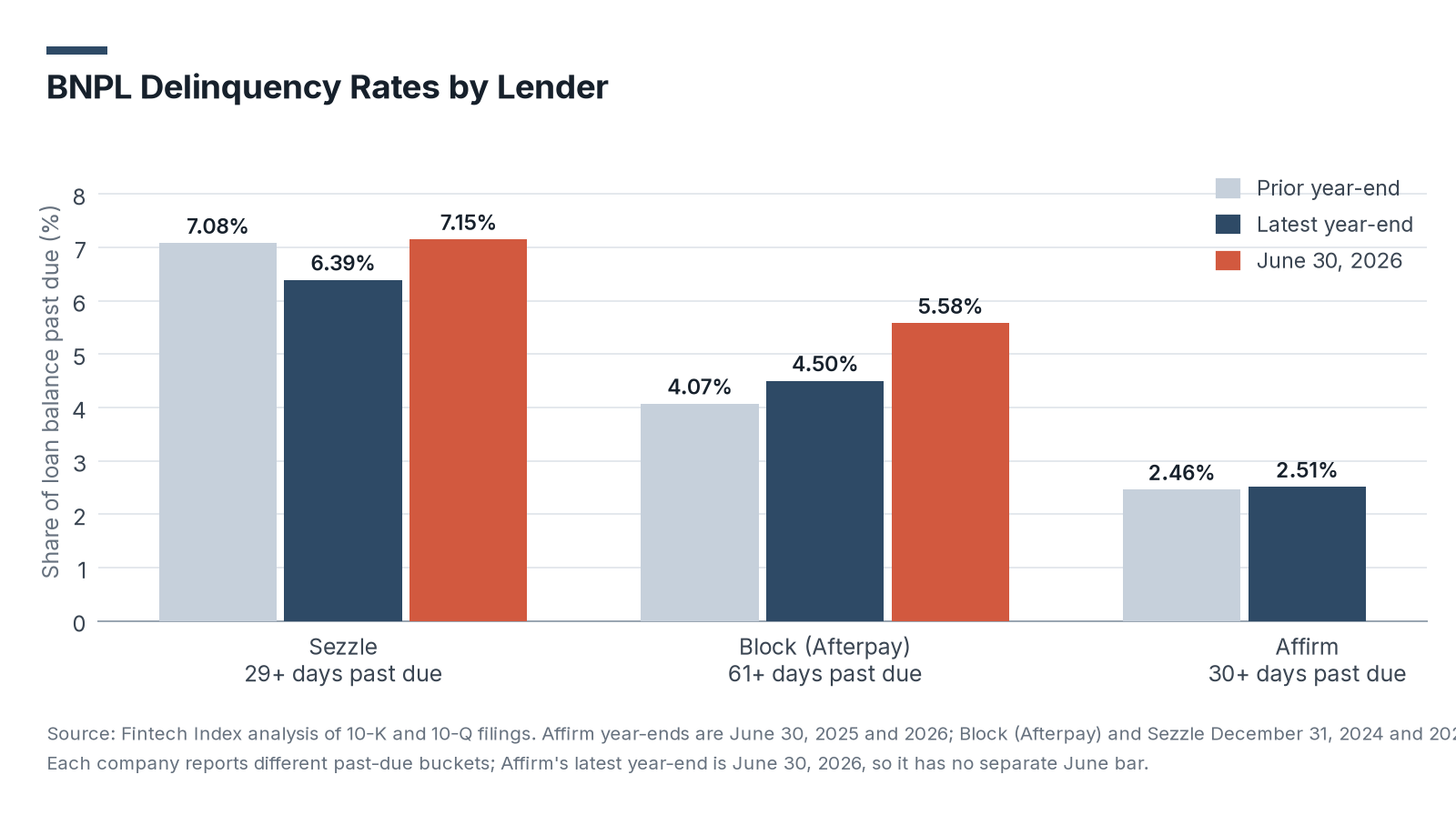
- At Block (Afterpay), loans 61 or more days past due rose to 5.58% of consumer receivables in June 2026, from 4.50% at the end of 2025 and 4.07% a year before that. Loans more than 90 days past due grew to $121.1 million from $101.0 million in the first six months of 2026, while total receivables fell to $2,718.6 million from $2,910.2 million.
- Sezzle's share of notes receivable 29 or more days past due fell to 6.39% at the end of 2025 from 7.08% a year earlier, then rose to 7.15% on June 30, 2026, above both year-end figures.
- Affirm's share of loans 30 or more days past due rose by five basis points, to 2.51%, while its loans held for investment grew to $9,466.4 million from $6,957.6 million.
- Late payments are rising at several lenders, an early sign of more write-offs ahead. Block's 61-day delinquency rose to 5.58% in June 2026, and Sezzle's reached 7.15%.
BNPL Loss Allowances as a Share of Loans
Sezzle set aside more for expected losses, relative to the loans it holds, than any other lender in this report: 10.06% of its notes receivable at the end of 2025 and 9.96% on June 30, 2026. A higher allowance means the lender expects a larger share of the loans it still holds to go unpaid.
| Lender | Product or Segment | Prior Year-End | Latest Year-End | June 30, 2026 |
|---|---|---|---|---|
| Sezzle | All notes receivable | 13.69% | 10.06% | 9.96% |
| Zip | US receivables | n/a | 8.7% (June 2026) | Same as latest year-end |
| Block (Afterpay) | Consumer receivables | 7.46% | 8.24% | 8.86% |
| Affirm | Loans held for investment | 5.70% (June 2025) | 5.95% (June 2026) | Same as latest year-end |
| Klarna | Financing | 4.2% | 5.9% | n/a |
| Klarna | Pay Later | 3.7% | 3.5% | n/a |
- Sezzle's allowance fell to 10.06% of notes receivable at the end of 2025 from 13.69%, while its allowance in dollars rose to $28.5 million from $26.1 million.
- Klarna's coverage on Financing loans rose to 5.9% from 4.2% as Financing receivables grew to $4,604 million from $3,085 million. Its Pay Later coverage fell to 3.5% from 3.7%.
- Lenders are setting aside more for longer loans than for pay-in-four plans. Klarna's coverage on Financing loans rose to 5.9% while Pay Later coverage fell to 3.5%. Klarna's Financing receivables grew to $4,604 million from $3,085 million over the same period.
BNPL Default Rates in the Second Quarter of 2026
April to June 2026 is the latest quarter each lender has reported.
| Lender | Measure | Same Quarter 2025 | Latest Quarter |
|---|---|---|---|
| Sezzle | Net charge-offs as % of GMV, April to June | 1.89% | 1.44% |
| Sezzle | Provision as % of GMV, April to June | 2.23% | 2.39% |
| Klarna | Provision as % of GMV, April to June | 0.56% | 0.52% |
| Zip (US) | Net bad debts as % of total transaction value, April to June | n/a | 1.67% |
- Klarna's provision for the second quarter of 2026 was $192 million on GMV of $36,648 million, against $174 million on $31,182 million a year earlier.
- Zip's US net bad debts were 1.52%, 1.84%, 1.86% and 1.67% of total transaction value in the four quarters of its fiscal 2026. Zip's presentation attributes the lower fourth-quarter figure to seasonal patterns and its own credit management.
- Recent quarters show loss provisions growing faster than volume at some lenders. Sezzle's provision rose to $30.6 million from $20.6 million, outpacing its GMV growth.
BNPL Charge-Off Rates Reported to the CFPB
The CFPB collected aggregate data on pay-in-four loans, those with four or fewer payments, from Affirm, Block (Afterpay), Klarna, PayPal, Sezzle and Zip for 2019 through 2023. Its December 2025 report gives two charge-off measures: the number of loans charged off as a share of all loans originated, and the dollar amount of loans charged off as a share of GMV, which the CFPB describes as total origination volume.
| Year | Share of Loans Charged Off | Charge-Offs as % of GMV |
|---|---|---|
| 2019 | 2.47% | 2.48% |
| 2020 | 1.85% | 1.18% |
| 2021 | 2.44% | 1.38% |
| 2022 | 2.63% | 1.71% |
| 2023 | 1.83% | 0.92% |
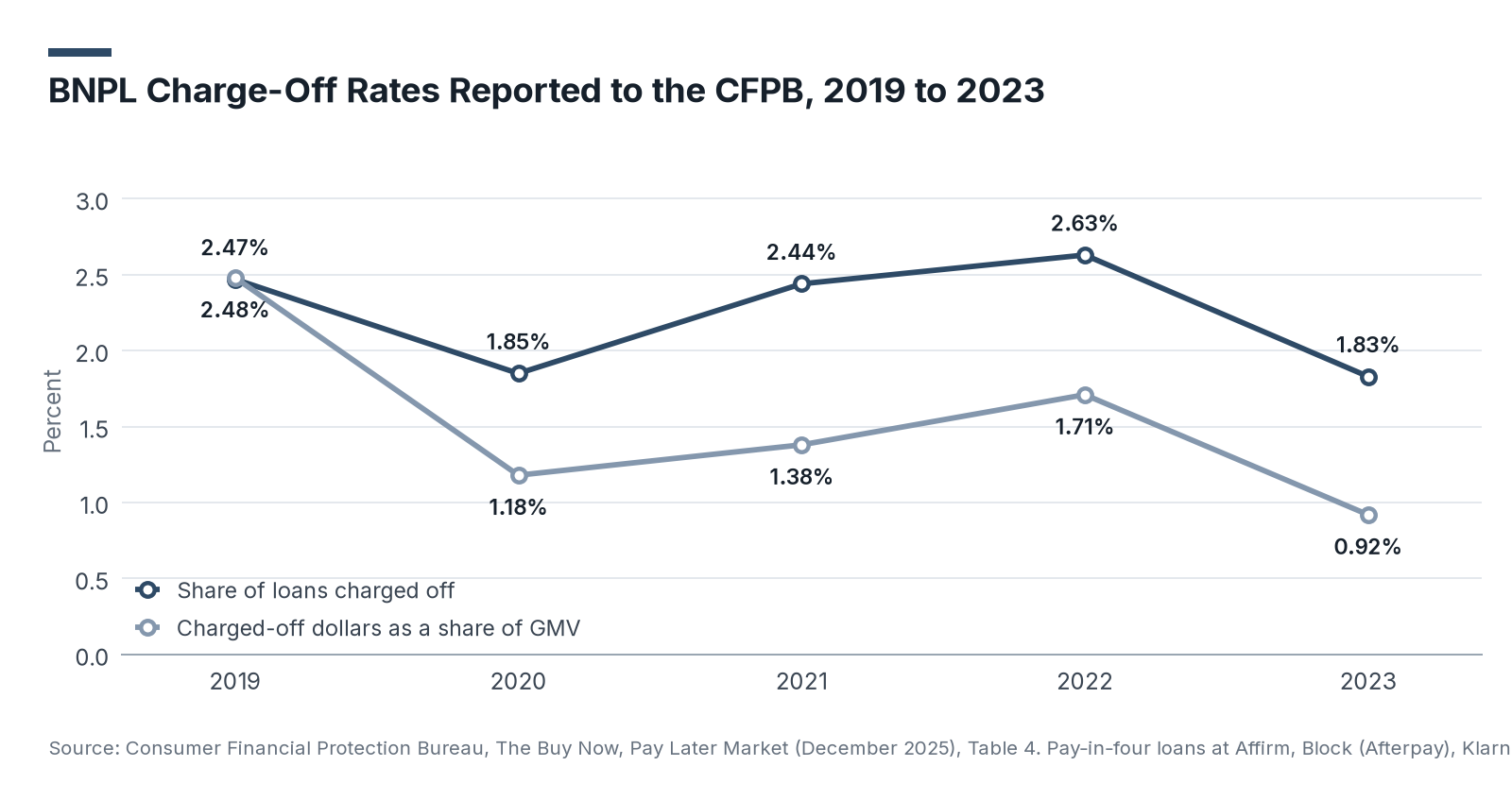
- Charged-off dollars fell to 0.92% of GMV in 2023 from 1.71% in 2022, the lowest level in the five years the CFPB covered.
- The CFPB's 2023 low point is now out of date as a benchmark. Charge-offs fell to 0.92% of GMV that year from 1.71% in 2022, but current lender figures run higher. Until the CFPB publishes newer data, company filings are the only current source.
What BNPL Default Rate Trends Mean for 2027 and Beyond
Buy now, pay later began as a small, short loan at checkout, and for most shoppers it still works that way. But more people are falling behind at several of the largest lenders, and those lenders are setting more money aside to cover loans that go unpaid, especially on the longer plans that make up a growing part of what they lend.
Two things could shift from here: how far lenders move into longer, larger loans, and whether the late payments of early 2026 turn into write-offs. If more of them do, lenders could approve fewer shoppers or charge more for each plan, which would change how easy these loans are to get at checkout.
So if you pay in installments, keep a list of every plan you have open and when each payment is due.
Data Collection and Methodology
The lenders write off unpaid loans at different points, which affects both their charge-off and delinquency figures.
- Sezzle charges off amounts delinquent for more than 90 days. Affirm charges off a loan when its principal is 120 days past due. Block (Afterpay) charges off consumer receivables when they are more than 180 days past due.
- At the end of 2025, the 1 to 60 days past due figure for Block (Afterpay) included $245.4 million of repayments that consumers had sent from their bank accounts but Block had not yet received. The 61-days-and-over figures in this report leave that bucket out.
- Block does not report GMV for Afterpay in its 2025 filings. Its provision for consumer receivables was $333.8 million in 2025 and its charge-offs were $302.6 million.
The credit loss, delinquency and allowance figures come from each company's latest annual report (a 10-K for Affirm, Sezzle and Block, a 20-F for Klarna and the full-year results for Zip, which is publicly traded in Australia) and from its latest quarterly figures published by October 8, 2026. Each of the five is publicly traded, and pay-over-time plans at checkout are its main business or a business it reports on its own. Affirm's fiscal year ended June 30, 2026, Zip's on the same date, and the others report on the calendar year.
A BNPL lender's default rate in this report is the share of the purchases it finances that it ends up writing off. A lender that writes off a net $1.50 for every $100 of purchases has a default rate of 1.5%. No lender in the set publishes a figure it calls a default rate. The report uses three measures the companies do publish. The first is net charge-offs, or Zip's "net bad debts," as a share of gross merchandise volume (GMV), the dollar value of purchases financed. The second is the share of loans past due, which each company measures from a different number of days. The third is the allowance for credit losses, the amount set aside for expected future losses, as a share of loans outstanding.
The CFPB comparison figures come from the Consumer Financial Protection Bureau's December 2025 market report, which covers pay-in-four loans at six large BNPL lenders through 2023, the latest year it reports.
Sources
- Fintech Index, BNPL Default Rate Study: analysis of 2025 to 2026 annual and quarterly reports from five publicly traded buy now, pay later lenders and the CFPB's December 2025 BNPL market report, conducted October 2026.
- Affirm annual report for fiscal 2026. Affirm Holdings, Form 10-K, August 27, 2026. Prior-year GMV of $36.7 billion is calculated from fiscal 2026 GMV of $50.2 billion and the reported increase of $13.5 billion.
- Klarna annual report for 2025. Klarna Group, Form 20-F, February 26, 2026.
- Klarna second quarter 2026 results. Klarna Group, Form 6-K, August 18, 2026.
- Sezzle annual report for 2025. Sezzle, Form 10-K, February 26, 2026.
- Sezzle quarterly report for the second quarter of 2026. Sezzle, Form 10-Q, August 7, 2026.
- Block annual report for 2025. Block, Form 10-K, February 26, 2026.
- Block quarterly report for the second quarter of 2026. Block, Form 10-Q, August 5, 2026.
- Zip FY26 results update. Zip Co, ASX announcement, August 20, 2026.
- Zip FY26 investor presentation. Zip Co, August 2026.
- The Buy Now, Pay Later Market: Data Spotlight. Consumer Financial Protection Bureau, December 2025.